
How to Fix Broken Business Processes: The Executive Guide to Ending Operational Friction

Updated: Jun 29
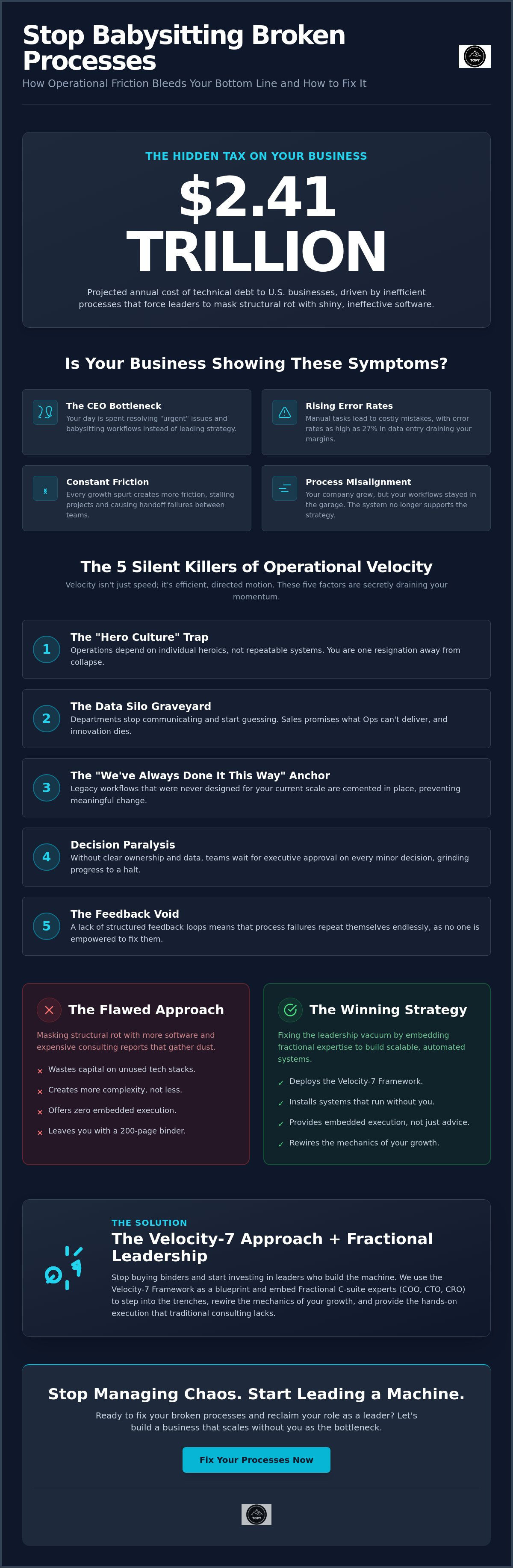
Why are you still paying for a $150,000 enterprise platform if you still have to babysit every single task? Technical debt is projected to cost U.S. businesses $2.41 trillion this year. Most of that waste comes from leaders trying to mask structural rot with shiny software subscriptions. If you're tired of being the permanent bottleneck in your own company, it's time to learn how to fix broken business processes by addressing the leadership vacuum, not the code.
You know the feeling of running a high-speed engine that's low on oil. Every growth spurt creates more friction, more manual errors, and more "urgent" messages that only you can resolve. It's a trap that kills scale and burns out the best executives. This guide changes that. We're going to stop the bleeding and introduce the Velocity-7 approach, a framework built to transform operational friction into profitable, automated flow. You'll learn how to build systems that don't require your constant input, ensuring your capital goes toward growth instead of fixing 27 percent error rates in manual data entry. It's time to stop managing chaos and start leading a machine.
Table of Contents
Your Processes Aren’t Just "Broken"—They’re Bleeding Your Bottom Line
Most executives treat operational friction like a minor headache. It's actually a hemorrhage. Every time a project stalls or a handoff fails, you're paying an invisible tax on your revenue. If you're searching for how to fix broken business processes, understand this: "broken" is rarely a total collapse. It's usually just misalignment. Much like how Upper Cervical Care focuses on correcting foundational alignment at the top of the spine to restore systemic health, your business requires precise structural integrity at the leadership level to function. Your company grew, but your workflows stayed in the garage. This friction is the silent killer of your EBITDA. It turns high-potential firms into sluggish bureaucracies that can't move without the CEO's permission.
If you're a CEO spending your day babysitting workflows, your process isn't an asset; it's a liability. You aren't leading. You're an overpaid supervisor. Operational friction is the gap between strategic intent and tactical execution. While a bottleneck is a temporary jam that can be cleared with more resources, a broken system is a structural failure. It doesn't matter how fast you drive if the wheels are square. To get back to winning, you must stop treating the symptoms and start rebuilding the engine through disciplined Business Process Management.
To better understand how these structural failures manifest and how technology plays a role, watch this helpful video:
The High Cost of the "Status Quo" in Mid-Market Firms
In high-growth hubs like Boston and Dallas, the "Friction Tax" is aggressive. Inefficiency drains your profit margins before you even see them on a balance sheet. Technical debt and inefficient processes cost U.S. enterprises $2.41 trillion a year as of June 2026. This isn't just a tech problem; it's a leadership failure. When your team works harder to compensate for a bad system, they burn out. You lose top talent, and your execution speed drops. Working harder is a tactical error that masks the need for a Fractional COO or a Fractional CTO to install scalable systems.
Why Traditional Consulting Audits Fail
Traditional consultants love thick binders. They'll charge you six figures to tell you what's wrong and then leave you with a 200-page PDF that nobody ever opens. These audits fail because they miss the cultural nuances of your market and offer zero execution. You don't need more advice; you need embedded execution. You don't learn how to fix broken business processes by reading a report. You fix them by having a Fractional CEO or Fractional CRO step into the trenches to rewire the mechanics of your growth. Stop buying binders and start investing in leadership that actually builds the machine.
The 5 Silent Killers of Operational Velocity
Velocity isn't just about speed. It's about direction and efficiency. You can't achieve it while dragging the weight of structural rot. Most executives realize they have a problem only when growth plateaus or margins shrink. By then, the damage is internal. If you want to know how to fix broken business processes, you have to stop looking at the results and start looking at the mechanics. These five killers are likely draining your momentum right now.
The first is the "Hero Culture" trap. You think you have a dedicated team because people are overworking to hit deadlines. In reality, you have a fragile system. If your operations depend on individual heroics rather than repeatable systems, you're one resignation away from a total collapse. This leads directly to the "Data Silo Graveyard." When departments stop communicating and start guessing, the friction increases. Sales promises what Ops can't deliver, and Finance wonders where the margin went. Innovation dies here, buried under the "We’ve Always Done It This Way" anchor. As Michael Hammer argued in his seminal piece on Reengineering Work, the goal shouldn't be to pave the cow paths. You must obliterate inefficient legacy workflows to find true speed.
Decision paralysis and the feedback void round out the list. Without clear ownership, your team hits tactical gridlock. Every minor choice becomes a meeting. Worse, if your systems don't have built-in alerts, you won't know a process has failed until a client leaves or a vendor sues. That's not management. That's damage control.
Identifying Friction in Your Sales and Tech Stacks
In aggressive markets like Chicago or Florida, a broken sales process is a "leaky bucket" you can't afford. Leads fall through the cracks because your CRM is too complex or your handoffs are manual. Technology should accelerate your business, not complicate it. If your tech stack requires a PhD to navigate, it's a bottleneck. You might need a Strategic Planning session to strip away the digital clutter and focus on what actually drives revenue. Remember: your tech isn't an asset if it slows you down.
The Human Element: Turnover as a Process Metric
High performers don't quit jobs; they quit friction. In the competitive Northeast talent market, your "A-players" are the first to leave a broken system. They want to win, not fight with a spreadsheet for four hours a day. Clarity is the ultimate retention tool. Standard Operating Procedures (SOPs) aren't meant to micromanage "B-players." They exist to free up your top talent for high-value work. When you master how to fix broken business processes, you stop losing your best people to competitors who simply have their act together. Stop the bleed. Build a machine that rewards talent instead of exhausting it.
Why "More Software" is the Most Expensive Mistake You’ll Make
Software is the ultimate distraction for an executive who doesn't want to do the hard work of leadership. It's easier to sign a SaaS contract than it is to confront a failing department head. But here is the reality: if your sales script is garbage, a high-end CRM just helps you lose leads more efficiently. You aren't solving a problem. You're just digitizing dysfunction. When you are figuring out how to fix broken business processes, the last thing you should do is open your wallet for a new vendor. Automation of a broken process only makes you fail faster.
Mid-market companies in Austin and West Coast tech hubs are the worst offenders of this "Shiny Object" fallacy. They are often over-tooled and under-led. They suffer from "Tool Creep," a condition where the tech stack is more complex than the actual business. This leads to massive hidden costs in training, integration, and data fragmentation. Your team spends more time updating the software than they do serving the customer. It's a cycle of waste that drains your EBITDA and creates a culture of "Zombie Software" that nobody actually uses correctly.
Logic First, Tools Second
Transformation has a strict hierarchy that you ignore at your own peril. It starts with Strategy, moves to Process, then People, and only then do you look at Tools. Most firms try to reverse this order. They buy the tool and hope it dictates the process. It never works. You need a process architect to design the workflow before you need a software vendor to host it. Software is an accelerant, not a cure. If you apply an accelerant to a fire, you get growth. If you apply it to a pile of trash, you just get a bigger, more expensive mess.
Auditing Your Current Tech ROI
Take a hard look at your balance sheet. How many subscriptions are you paying for that your team actively hates? Identifying "Zombie Software" is the first step toward operational sanity. This requires a Fractional CTO perspective to evaluate tech-debt and process alignment. A Fractional CTO doesn't just look at the code; they look at the ROI of every byte of data. They ensure your systems serve your strategy instead of your strategy being limited by your systems. Stop being a hostage to your tech stack and start demanding that your tools actually produce a measurable return on investment.
The Velocity-7 Approach to Process Transformation
Generic business advice tells you to "optimize" or "improve." We tell you to transform. If you want to know how to fix broken business processes, you need a battle-tested roadmap, not a suggestion box. The Velocity-7 Adaptive Framework is that roadmap. It moves your business from friction to flow by treating operations as a dynamic system rather than a static set of rules. This isn't about minor tweaks; it's about a total rewiring of how your company executes.
Step 1: The Audit. We identify the Seven Dimensions of Growth. If one lags, the whole machine shakes. We find the rot before we build the cure.
Step 2: The Pruning. We eliminate redundant steps that add zero value to the customer. If a task doesn't contribute to the bottom line or the client experience, it's waste. Cut it.
Step 3: The Alignment. We connect C-suite strategy directly to frontline execution. This ensures that every tactical action taken by your team serves your high-level vision.
Step 4: The Embedding. We don't just hand you a plan and walk away. We embed fractional leadership to drive the change and ensure the new systems stick.
Most "fixes" fail because they're band-aids on a structural failure. By following this framework, you stop guessing and start measuring. If you're ready to stop the bleeding and install a system that scales, explore our Velocity-7 Adaptive Framework today.
Moving from Operational Friction to Efficient Flow
In a high-stakes business environment, "Flow" is the state where the system works without your constant intervention. Mid-market companies often fail here because they try to implement rigid corporate SOPs that kill agility. You don't need a 500-page manual. You need an "Adaptive" framework that allows for speed and pivots. We bring Agile-based transformation to non-tech departments, ensuring that Sales, Finance, and Ops all move at the same tempo. When your processes have flow, growth happens by design, not by accident.
The 90-Day Transformation Roadmap
You don't have years to wait for results. Our 90-day roadmap is designed for speed. In the first 30 days, we focus on the Audit and identifying "Quick Wins." These are low-hanging fruit improvements that immediately free up cash or time. These wins fund the long-term transformation and build team buy-in. By day 60, we are pruning and aligning. By day 90, the new systems are embedded and running. You can see the full breakdown in our guide on Implementing Velocity-7: A 90-Day Roadmap. It's time to master how to fix broken business processes and get back to the work of winning.
Fixing the Foundation: Fractional Leadership as the Catalyst
You can't solve a problem with the same level of thinking that created it. If your operations are stalling, it’s because your current leadership structure has reached its ceiling. Most executives searching for how to fix broken business processes make the mistake of asking their existing team to "work harder." This is a recipe for burnout, not breakthrough. Real transformation requires a catalyst. It requires someone who can see the structural rot that your team has become blind to over years of "just making it work."
This is where the fractional model changes the game. You don't need to commit to a $300,000 annual salary plus equity to get C-suite expertise. A Fractional COO, Fractional CTO, or Fractional CFO provides the strategic surgical strike you actually need. While Interim Leadership is often a band-aid for a sudden vacancy, fractional leaders are architects of sustainable growth. At Top7, our seasoned professionals don't just hand you a report. They embed directly with your team to dismantle friction and install the Velocity-7 framework. We solve complex problems by actually doing the work, not just talking about it.
Fractional COO vs. Full-Time Hire
For mid-market companies in high-velocity hubs like Boston or Austin, the ROI on fractional leadership is undeniable. You get 100 percent of the experience for a fraction of the cost. Part-time expertise often delivers full-time results because a fractional leader isn't bogged down by internal politics or legacy culture. They are focused solely on operational velocity. In many cases, even a full-time CEO might be a mistake for your business if the real need is for a systems architect rather than a figurehead. You need a builder, not just a manager.
Ready to Stop the Bleeding?
The cost of waiting is always higher than the cost of fixing. Every day you delay is another day of wasted capital, manual errors, and executive burnout. You now know how to fix broken business processes: you audit the friction, prune the waste, and install the right leadership to drive the change. The first step toward operational flow is a clear, unvarnished look at your current state. Stop babysitting your workflows and start leading your company. It is time to move from friction to flow. Schedule a call with a Top7 Executive to audit your friction points.
Stop Managing Chaos and Start Leading a Machine
Operational friction is a tax you can no longer afford to pay. You've seen how "hero culture" and excessive tool creep are draining your EBITDA and burning out your top talent. Learning how to fix broken business processes isn't about buying another expensive SaaS subscription. It's about installing a leadership-led framework that turns friction into profitable flow. You need an engine that runs without your constant intervention so you can focus on strategic dominance instead of tactical fires.
The Velocity-7 Adaptive Framework was built specifically to solve the unique growth obstacles mid-market companies face. Our experienced C-suite veterans don't just hand over a report; they embed in your team to drive measurable results and system-wide alignment. You have the roadmap. Now you need the execution. Stop letting structural rot dictate your company's ceiling and start building the machine your vision deserves. It's time to win again.
Move from Friction to Flow. Schedule Your Velocity-7 Audit Today.
Operational Friction: Frequently Asked Questions
What are the first signs that my business processes are actually broken?
The most obvious sign is the CEO acting as a permanent bottleneck. If you can't take a week off without the wheels falling off, your system is a liability. You'll also see high error rates in manual data entry and a "hero culture" where one person overworks to save the day because the process failed them. These aren't just quirks; they are structural leaks draining your profit.
How long does it typically take to fix a major operational bottleneck?
You should see tactical results within 30 days. We target "Quick Wins" early to fund the transformation and build momentum. A full structural overhaul using a framework like Velocity-7 typically takes 90 days to embed and stabilize. Speed is the goal, but sustainability is the metric that matters for your bottom line.
Can I fix my business processes without hiring a full-time COO?
Yes, and for most mid-market firms, you should. Hiring a full-time COO is often an unnecessary capital drain that takes six months to ramp up. Fractional leadership gives you the same architectural expertise and execution power for a fraction of the cost. You get the builder you need without the $300,000 salary commitment.
Will a new CRM or ERP system fix my operational friction?
No. Technology is an accelerant, not a cure. If your sales script is garbage or your handoffs are manual, a new CRM just helps you lose leads more efficiently. You must master how to fix broken business processes at the logic level before you ever sign a software contract. Fix the flow, then buy the tool.
What is the difference between a business consultant and a fractional leader?
Consultants sell advice in thick binders that your team will never read. Fractional leaders sell execution. They don't just tell you what's wrong; they embed in your team and take ownership of the results. Consultants are spectators; fractional leaders are participants in your growth.
How much does it cost to implement a framework like Velocity-7?
The investment depends entirely on the complexity of your friction points and the scale of your business. We don't offer flat-rate packages because we don't offer generic solutions. The real question is the cost of your "Friction Tax." The money you're losing to inefficiency right now is almost certainly higher than the cost of the fix.
Is my company too small to benefit from a Fractional CTO or COO?
Size is irrelevant; complexity is the trigger. If your operational friction is preventing you from scaling to the next level, you need specialized leadership. Waiting until you are "big enough" often ensures you never get there. If the engine is smoking, you fix it now or you'll never hit top speed.
How do I get my team to buy into new processes without causing turnover?
Solve their pain. High-performers hate friction more than anyone else on your payroll. They're exhausted by the manual workarounds and the constant "fire drills" caused by bad systems. When you show them how to fix broken business processes to remove their daily headaches, they don't quit; they excel. Clarity is the ultimate retention tool for "A-players."



Comments