
Full-Time vs. Fractional C-Suite Cost Analysis: The Brutal Truth for 2026

Is your C-suite a strategic engine or just a glorified cash furnace? In 2026, mid-market CEO total compensation packages are regularly hitting the $4 million mark, yet most founders still tolerate a six month ramp up period where zero value is actually created. You're likely feeling the sting of skyrocketing executive salaries and the heavy weight of equity expectations that dilute your own stake. It's time for a brutal full-time vs fractional c-suite cost analysis that exposes the reality of your current burn rate.
Stop leaking capital on legacy payroll structures that prioritize ego over execution. You deserve a clear financial justification for every dollar spent on leadership. This guide provides the exact math behind fractional ROI, showing you how to slash executive costs by 40% to 60% while maintaining elite strategic quality. We'll break down the hidden "on-costs" that recruiters won't tell you about and show you how to deploy the Velocity-7 framework to drive faster results. It's time to trade operational friction for high-octane growth.
Key Takeaways
Expose the hidden "invisible costs", from 30% recruitment fees to payroll taxes, that make traditional executive hiring a capital-heavy risk in 2026.
Execute a precise full-time vs fractional c-suite cost analysis to reallocate wasted payroll into high-impact growth initiatives immediately.
Leverage the "Zero-Politics" advantage of fractional leadership to focus entirely on measurable results rather than internal career laddering.
Apply the Decision Matrix to audit your company's current velocity and identify if you require a steady-state hire or a transformation specialist.
Transition from operational friction to flow using the Velocity-7 Adaptive Framework to ensure your leadership team drives execution, not just meetings.
Table of Contents
The Visible vs. Invisible Costs of C-Suite Leadership
Executive compensation in 2026 isn't just rising; it's cannibalizing mid-market margins. While revenue growth for many firms has plateaued, C-suite salaries have reached a permanent premium. You're likely staring at a balance sheet wondering why your leadership costs more than your actual product development. Understanding What is a Fractional Executive? is no longer an academic exercise. It's a survival tactic for founders who refuse to let bloated payrolls kill their burn rate.
The "Great Resignation" left a scar on the talent market that hasn't faded. Top-tier operators now demand "at-risk" compensation that accounts for 70-80% of their total pay. This shift has pushed total packages for mid-market roles into the millions. If you're still budgeting based on 2022 data, you're already losing the war for talent and profit. A cold, hard full-time vs fractional c-suite cost analysis is the only way to see where your capital is actually bleeding out.
To better understand how the market shifted toward flexible leadership, watch this helpful video:
The 2026 Executive Compensation Reality
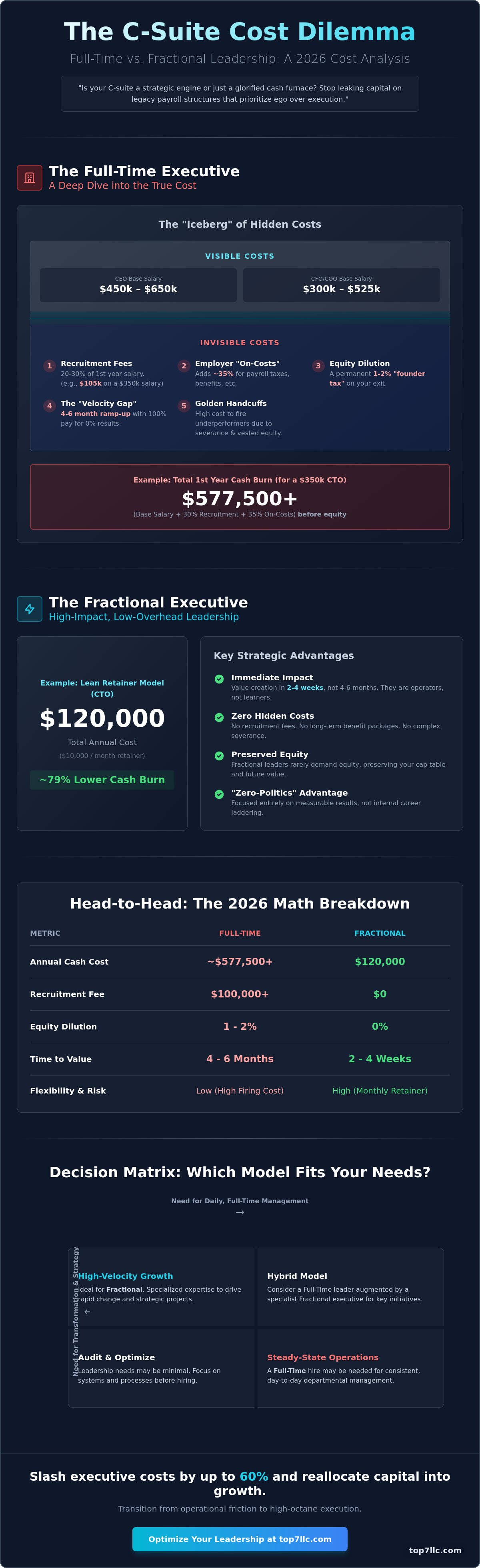
In the US, mid-market CEO base salaries now range from $450,000 to $650,000. CFOs and COOs aren't far behind, commanding between $300,000 and $525,000 just to show up. These figures are just the "visible" layer. Your total payroll burden, including 2026's updated employer contributions and specialized executive healthcare mandates, effectively adds 35% to every dollar of base salary you commit to a full-time contract. You're paying for potential, but you're billed for existence.
Equity Dilution: The Hidden Founder Tax
Giving away 1% to 2% of your company to a full-time hire is a permanent tax on your eventual exit. Fractional leaders rarely demand equity. They focus on results and retainers, preserving your cap table for future funding rounds or your own pocket. You also avoid the "Golden Handcuffs" problem. This happens when a full-time hire stops performing but remains too expensive to fire due to severance and vested shares. Fractional models allow you to cut ties the moment the ROI dips, keeping your organization lean and aggressive.
Then there's the "Velocity Gap." Retained search fees for full-time hires typically sit at 20% to 30% of the first-year salary. If you hire a $400,000 CFO, you're cutting a $100,000 check to a recruiter before the executive even finds their desk. Every month you spend interviewing is a month your competitors are out-executing you. In 2026, speed is a currency, and slow hiring is a debt you can't afford to carry.
Full-Time vs. Fractional C-Suite: The 2026 Math Breakdown
Numbers don't have egos. They don't care about your "culture fit" or your office perks. When you run a full-time vs fractional c-suite cost analysis, the spreadsheet tells a story of massive capital inefficiency. Take a standard $350,000 full-time CTO. By the time you cut a 30% check to a retained search firm ($105,000) and layer on the 35% employer on-costs, you've burned nearly half a million dollars before they've even pushed their first line of strategic code. Compare that to a Fractional CTO on a $10,000 monthly retainer. You're looking at $120,000 a year for the same level of architectural oversight without the half-million-dollar anchor around your neck.
The "Ramp-Up" period is where most mid-market companies lose their competitive edge. A full-time executive typically takes four to six months to "integrate" and create actual value. During this window, you're paying 100% of the salary for 0% of the results. Fractional leaders are different. They're operators, not learners. They land with a mandate to fix specific leaks within two to four weeks. This isn't just about saving pennies; it's about the Strategic ROI of Fractional Leadership where you pay for outcomes, not attendance.
Total Cost of Ownership (TCO) Comparison
Your P&L is likely cluttered with the "tail" of executive employment. Payroll taxes, premium health insurance, 401k matching, and executive travel stipends add up to a bloated line item that's hard to trim. Fractional retainers collapse this complexity into a single, predictable monthly invoice. A fully-loaded CFO in Austin, Texas, commands a total package exceeding $600,000 when accounting for local market premiums and benefits, while a fractional alternative delivers the same strategic output for less than a third of that capital outlay. If you're ready to stop the bleeding, you can audit your current leadership burn rate to see exactly where your capital is being mismanaged.
The ROI of Immediate Strategic Ownership
Full-time hires often spend their first 90 days in "discovery mode," which is just corporate-speak for being lost. Fractional leaders are plug-and-play. A Fractional CTO can audit your tech stack, identify security vulnerabilities, and streamline your dev-ops pipeline in 10 days. They don't need a desk; they need a target. Our Velocity-7 Framework accelerates this value capture by stripping away the fluff and focusing on the seven critical dimensions of growth. You aren't just hiring a person. You're installing a system for execution that bypasses the traditional six-month learning curve entirely.
Don't forget the exit costs. A full-time "mismatch" is a disaster. Between severance packages, legal fees, and the cost of another recruiter search, a bad hire can set your company back two years. Fractional engagements are built on performance. If the value isn't there, you pivot without the legal drama or the six-figure settlement. It's time to stop treating leadership as a permanent liability and start treating it as a strategic, scalable asset.
Beyond the Spreadsheet: The Strategic ROI of Fractional Leadership
If you think the only reason to go fractional is to save $300k in payroll, you're still playing checkers. While the full-time vs fractional c-suite cost analysis proves the immediate capital advantage, the real profit lies in the "Opportunity Cost of Speed." In 2026, market share is won by the agile, not the overstaffed. A full-time executive is incentivized to build an empire and protect their seat. A fractional leader is incentivized to deliver results and move the needle before their next board report. Politics is a tax on profit; fractional leadership is the tax shelter.
Consider the power of cross-pollination. A leader dedicated to a single company for five years develops tunnel vision. They solve problems using the same tired playbook. A fractional executive working with three high-growth companies sees patterns you don't. They've likely solved your "unique" operational bottleneck twice this month already. They don't need to "learn" your industry for 90 days; they bring the solutions from the front lines of the entire market. You aren't just buying hours. You're buying a distilled library of winning tactics.
Eliminating Operational Friction
Founders are often too close to the fire to see the smoke. A Fractional COO acts as an objective outsider who can identify structural bottlenecks without fear of offending the "old guard." Using our Velocity-7 Adaptive Framework, these leaders measure impact across seven critical dimensions, moving your organization from friction to flow in under 90 days. They don't care about the holiday party or the internal hierarchy. They care about the system's output. This clarity allows for an agile transformation that full-time hires, bogged down by internal optics, simply cannot execute.
Access to the 'Elite 1%' of Talent
The talent landscape has shifted permanently. By 2026, the top 1% of executive talent has realized they can earn more and stay sharper by managing a portfolio of companies rather than tethering themselves to one. Fractional leadership allows a mid-market firm in Chicago or Florida to secure a Silicon Valley-level Fractional CTO who would otherwise demand a $2M package and 5% equity.
It's also vital to distinguish between "Interim" and "Fractional" roles. Interim leadership is a band-aid used to fill a temporary gap. Fractional leadership is a long-term strategic partnership. You get the heavy-hitting expertise of a veteran operator who owns your KPIs and drives your roadmap, but without the bloated overhead of a full-time contract. You can dial this leadership up during a massive scale-up phase or dial it down once the system is stabilized. It's leadership on demand, optimized for your 2026 roadmap.
The Decision Matrix: When to Hire Full-Time vs. Fractional
Stop looking at your bank balance and start looking at your calendar. The most dangerous mistake founders make is treating leadership as a binary choice based on budget. It isn't. Your full-time vs fractional c-suite cost analysis must account for the "Cost of Inaction." If your roadmap is stalled because you're waiting six months to find a "unicorn" full-time hire, you aren't saving money. You're losing market share. Deciding between these models requires a tactical audit of your company's current phase and the specific problems you're trying to solve.
First, audit your current velocity. Are you moving fast enough to hit your 2026 targets? If the answer is no, you don't have time for a traditional search. Second, determine if the role is "Steady State" or "Transformation Focused." If you need someone to build a department from scratch or fix a broken system, you need a builder, not a maintainer. Builders are often bored by the day-to-day grind of a 40-year career in one seat. They thrive in fractional roles where they can solve high-complexity problems and move on. If you're tired of guessing which path to take, get a precise leadership gap audit to stop the capital leakage today.
Signals That You Need a Fractional Leader NOW
Strategic Project Deadlock: You have a clear roadmap but no senior operator to own the execution.
The Mentorship Gap: Your mid-level team is talented but spinning their wheels because they lack a veteran mentor to guide their growth.
Exit or Funding Preparation: You're planning a major event in the next 12 months and need a Fractional CFO or COO to clean up the books and operations to maximize valuation.
When Full-Time is Actually the Better Bet
Fractional leadership isn't a silver bullet for every scenario. When a role requires 50 or more hours a week of deep, granular operational management, a full-time hire is the correct move. This is typical for mature, stable-state organizations where the systems are already built and just need consistent supervision. Additionally, if your company culture is in a state of total crisis, you may need a 24/7 physical presence to rebuild morale and trust. We recommend full-time hires for roles where the volume of work is high but the complexity has become predictable.
Analyze your cap table before making a move. Giving away 2% equity to a full-time hire who might not be the right fit in 18 months is a permanent founder tax. Fractional leaders allow you to solve the complexity problem without diluting your ownership. If the problem is "volume," hire full-time. If the problem is "sophistication," go fractional. Every day you spend in a hiring search is a day your competitors are gaining ground. Calculate your cost of delay; it's usually higher than the executive's salary.
Implementing Fractional Leadership with the Velocity-7 Framework
Hiring a person is a gamble. Implementing a system is a strategy. Most founders treat leadership like a recruitment problem, but it's actually an execution problem. While your full-time vs fractional c-suite cost analysis might show you the savings on paper, the real win is how those savings are deployed through a rigorous framework. We don't just hand you a resume and wish you luck. We install our proprietary Velocity-7 Adaptive Framework to turn your operational friction into measurable flow. This isn't about filling a seat. It's about upgrading the entire engine of your business.
Our Fractional CTOs and COOs don't sit on the sidelines. They embed directly into your Slack channels, join your stand-ups, and become part of your culture from day one. They own their KPIs with the same intensity as a founder, but without the baggage of a traditional employment contract. They aren't consultants giving advice from a distance. They are operators in the trenches, focused on the seven dimensions of growth that move the needle. You get elite-level execution without the permanent liability of a legacy payroll structure.
The Top7 Difference: Results, Not Resumes
The biggest objection to fractional leadership is the "commitment" myth. Critics think a part-time leader means part-time results. That's a fundamental misunderstanding of how high-level output works. A veteran operator can achieve more in ten hours of focused strategic work than a "learner" can in forty hours of busy work. Our Velocity-7 Adaptive Framework provides a rigid roadmap for the first 90 days. We identify the leaks, stabilize the core, and then accelerate. Our executives are incentivized by your growth and the success of the system, not by how many years they can stay on your payroll.
Ready to Stop Leaking Cash?
Waiting until next quarter to fix your leadership gap is a $50,000 mistake. Every month you operate without clear strategic oversight is a month of wasted dev hours, inefficient marketing spend, and stalled operations. You don't need to disrupt your current team to start. A fractional engagement is a surgical strike. We enter, we optimize, and we scale. You maintain total control over your burn rate while gaining access to the type of talent that usually requires a seven-figure package.
It's time to stop the capital hemorrhage. If you're ready to see exactly where your organization is losing momentum, your next step is a Velocity Audit. We'll look at your current structure and show you how a fractional model can reallocate your capital for maximum impact. Don't let another month of bloated payroll eat your margins. You can Scale smarter with a Top7 Fractional Executive and start leading with data, not just hope. The math is clear. The only question is whether you're fast enough to act on it.
Reallocate Your Capital for Maximum Velocity
Your current executive payroll is either a strategic asset or a heavy anchor. This full-time vs fractional c-suite cost analysis proves that the legacy model of bloated salaries and equity dilution is a choice you no longer have to make. You've seen the math. You know the invisible costs of ramp up time and recruitment fees are draining your burn rate. Now it's time to choose speed over tradition. The market in 2026 doesn't reward those who move slowly; it rewards those who optimize for execution.
Our team brings seasoned professionals with over 20 years of C-suite experience directly into your organization. Whether you're based in Dallas, Boston, or Chicago, we provide local expertise backed by our proprietary Velocity-7 Adaptive Framework. We don't just fill gaps; we install a high-performance system designed to scale. Stop overpaying for potential and start investing in proven results. Your cap table and your P&L will thank you.
Ready to see the difference in your own numbers?
Take the first step toward a leaner, more aggressive leadership structure. Your growth is waiting.
Frequently Asked Questions
Is a fractional C-suite executive as committed as a full-time hire?
Commitment is measured by results, not by how many hours someone sits in an office chair. Fractional leaders are high-level operators who thrive on efficiency and strategic impact. Their professional reputation depends entirely on hitting your KPIs quickly and effectively. Unlike full-time hires who might coast on a guaranteed salary, fractional executives are only as good as their latest delivery. They are incentivized to perform, not just to occupy a seat.
How many hours per week does a fractional executive typically work?
Most engagements range from 5 to 15 hours per week depending on the complexity of your current roadmap. This isn't "part-time" effort; it's concentrated strategic leadership. We focus on high-leverage activities like architectural audits, financial modeling, or operational scaling. If a role eventually requires a 50-hour weekly operational grind, that's the signal to transition to a full-time hire.
What is the average cost of a fractional CTO vs. a full-time CTO in 2026?
A 2026 full-time vs fractional c-suite cost analysis reveals that a full-time CTO often commands $450,000 or more when you include bonuses and equity. A fractional counterpart typically costs between $100,000 and $250,000 annually without any equity dilution. You're effectively buying the same strategic brain for less than half the total capital outlay. This allows you to reallocate that saved capital into your core product development.
Can a fractional executive help us raise venture capital or private equity?
Yes, having a veteran C-suite leader on your team provides immediate credibility during the due diligence process. Our Fractional CFOs and CEOs often lead the preparation for major funding rounds or exits. They clean up the books, optimize operations, and present a professional front that significantly reduces investor risk. They bring the "big company" polish that mid-market firms often lack during high-stakes negotiations.
What happens if we need to transition from fractional to full-time later?
Transitioning to a full-time hire is a sign of successful growth. We help you build the systems and documentation so a permanent hire can step into a functional environment rather than a chaotic mess. Our fractional leaders often assist in the search and vetting process for their permanent replacement. This ensures your growth velocity doesn't drop during the hand-off period.
Does a fractional leader manage my existing full-time employees?
Absolutely. A Fractional COO or CTO is an embedded operator who manages your existing team, leads stand-ups, and holds individuals accountable. They aren't just advisors; they are managers who own the departmental KPIs. They provide the senior mentorship your mid-level managers need to level up their own performance. They integrate directly into your workflow to drive team execution.
How does fractional leadership work for companies in different time zones?
We utilize a hybrid model that prioritizes asynchronous communication and key synchronous touchpoints. Our leaders are experts in modern digital collaboration tools, ensuring that time zones never stall execution. We align our schedules with your critical meetings to maintain a seamless operational rhythm. Effective leadership in 2026 is about the quality of the output, not the location of the person.
What is the typical contract length for a Top7 fractional engagement?
Most engagements begin with a 6-month commitment to allow for the full implementation of our Velocity-7 Framework. This provides enough runway to move from the initial audit phase to measurable growth. However, we offer the flexibility to scale the engagement up or down as your strategic needs evolve. We focus on long-term value, not trapping you in an inflexible contract.



Comments