

Fractional Executives for Mid-Market Companies: Stop Hiring for Payroll, Start Hiring for Flow
- Robert Fitzgerald
- May 14
- 12 min read

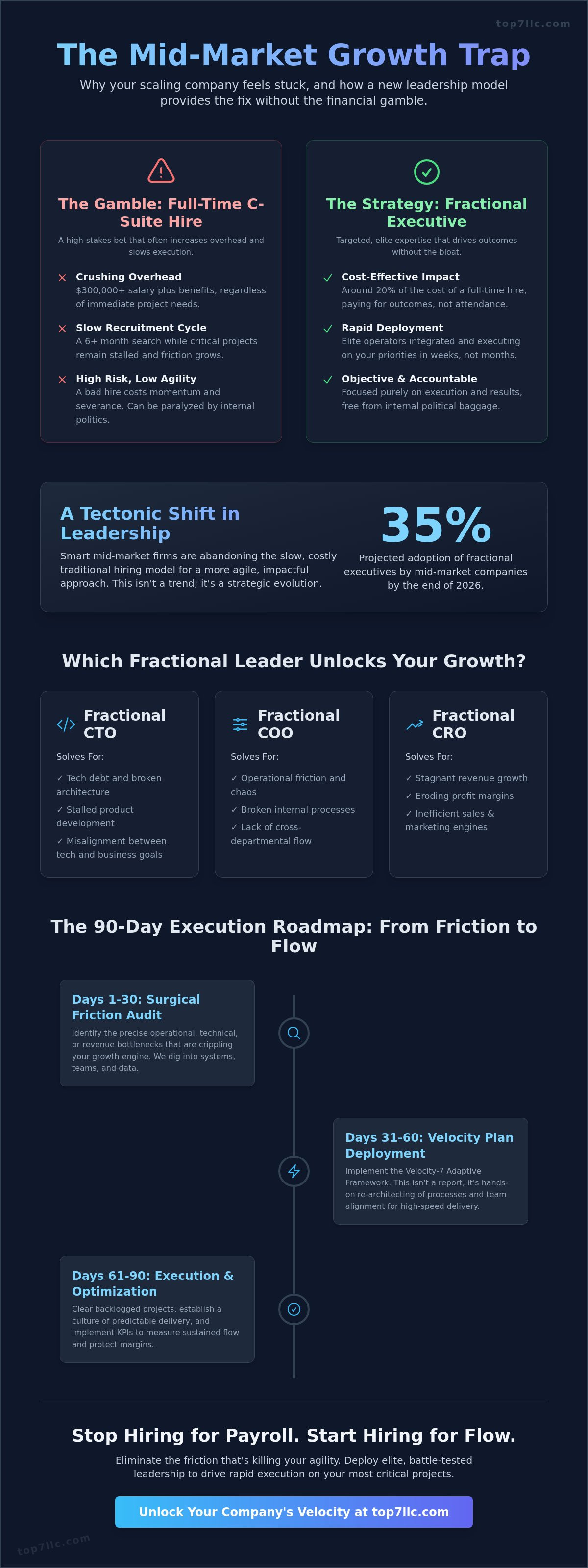
Your latest $300,000 C-suite hire isn't a strategic investment; they're a high-stakes gamble that's likely killing your agility. In the mid-market, growth often outpaces leadership capability, creating a friction point that grinds execution to a halt. You don't need another heavy payroll entry to sit in meetings. You need elite operators who move the needle today. This is why the adoption of fractional executives for mid-market companies is projected to hit 35% by the end of 2026. Smart firms are realizing that traditional full-time roles often lead to bloated overhead and stagnant projects.
You've felt the "Mid-Market Trap" where delivery lags and operational friction eats your margins. It's a brutal reality when your scale stalls because your leadership team lacks the battle-hardened experience to handle new complexity. This article will show you how to eliminate that friction and scale using high-level leadership without the crushing risk of a bad permanent hire. You'll discover how the Velocity-7 Adaptive Framework and fractional roles like a CTO, COO, or CRO can drive rapid execution on your stalled projects. It's time to stop hiring for payroll and start hiring for flow.
Key Takeaways
Stop paying the "friction tax" by identifying why your company's growing complexity is currently outstripping your leadership's ability to execute.
Discover why the traditional 40-hour executive model is a myth and how fractional executives for mid-market companies provide elite impact without the permanent payroll burden.
Master the Velocity-7 Adaptive Framework to dismantle stagnant systems and replace them with a culture of high-speed, predictable delivery.
Follow a 90-day execution roadmap to move from a surgical friction audit to a fully operational velocity plan that clears your backlogged projects.
Determine whether a Fractional CTO, COO, or CRO is the specific tactical asset required to resolve your current bottleneck and protect your margins.
Table of Contents
The Mid-Market Growth Trap: Why Your $50M Company Feels Like a $5M Mess
You hit the $50M revenue mark and suddenly the wheels are wobbling. It's the Mid-Market Trap. Your complexity has outpaced your leadership systems, and the ad-hoc methods that got you here are now your biggest liability. You're trying to run a sophisticated operation with a "hustle" mindset, but the math doesn't add up anymore. This gap between your current revenue and your leadership's ability to manage it creates a vacuum that sucks the life out of your growth.
This vacuum manifests as operational friction. It's a hidden tax that bleeds your revenue and destroys team morale. Most CEOs respond to this by reflexively hiring more full-time staff. That's a strategic blunder. Adding more bodies to a broken system just increases communication overhead and slows you down further. You don't need more payroll; you need better flow. High-performing fractional executive talent allows you to bridge this gap without the permanent weight of a $300k salary.
To better understand how this leadership shift works, watch this insight into the model:
Unlike consultants who drop a heavy report and vanish, fractional executives for mid-market companies are pure operators. They don't just give advice; they own the execution. While a consultant tells you your tech is broken, a fractional leader actually fixes the architecture and manages the team to delivery. It's the difference between a map and a driver. In a high-stakes environment, you don't need more maps. You need someone to take the wheel and hit the gas.
Recognizing the Signs of Executive Burnout and Friction
Is every decision waiting for your approval? That's the CEO bottleneck. If your top-level decision-making has stalled, or if you're discovering tech debt and financial leaks that no one seems to own, you're in the trap. Friction isn't just a buzzword; it's the sound of your growth engine seizing up. When your best people are spending 80% of their time on internal politics or "fixing" broken processes, you aren't scaling. You're just surviving.
Why Traditional Recruitment Fails the Mid-Market in 2026
Traditional recruitment is too slow for the 2026 market. You can't wait six months for a headhunter to find a "perfect" candidate when you have a two-week execution crisis. The risk is also too high. A bad executive hire can cost you hundreds of thousands in lost momentum and severance. Plus, Fortune 500 talent often chokes in a lean mid-market environment because they're used to massive budgets and layers of middle management. You need agility and grit, not a corporate resume and a bloated ego.
Payroll is Not a Strategy: Why Fractional Executives Outperform Full-Time Hires
Stop mistaking a high payroll for a high-performance culture. Most mid-market CEOs believe they need a full-time body in every C-suite chair to maintain control. It's an expensive delusion. An executive's value isn't measured by how many hours they spend in your Slack channels or at the water cooler. It's measured by the speed and quality of their decisions. When you hire for payroll, you're paying for attendance. When you hire for flow, you're paying for outcomes.
The "40-hour myth" is a relic of the industrial age. In reality, a high-level leader does their most impactful work in concentrated bursts of strategic clarity. By utilizing fractional executives for mid-market companies, you're buying 25 years of battle-tested experience for roughly 20% of the cost of a full-time hire. You get the results without the bloat. This model allows you to access elite talent that would otherwise be priced out of your current revenue bracket.
There's also the Objectivity Factor. Full-time hires are often paralyzed by internal politics because their mortgage depends on staying in your good graces. A fractional leader doesn't have that baggage. They're here to fix the friction, not win a popularity contest. They have the professional distance to tell you the hard truths your internal team is too scared to whisper. This honesty is what drives rapid execution on stalled projects.
The ROI of Fractional Leadership vs. Full-Time Salaries
When you calculate the "Fully Loaded" cost of a full-time executive, the numbers are staggering. You aren't just paying a salary. You're paying for health insurance, 401(k) matches, performance bonuses, and often a significant equity stake. By early 2026, research showed that 25% of U.S. businesses had already shifted to fractional models to avoid these compounding costs. The Time-to-Value metric is where you win. A fractional leader is embedded and executing within days, not the months it takes to onboard a permanent hire. If you're ready to stop the bleeding, you should evaluate your leadership gaps now.
Execution-First: Holding the Title and Owning the Outcome
Don't confuse this with "project consulting." A consultant gives you a slide deck and a bill. A fractional executive takes the title, manages the team, and owns the outcome. They bridge the leadership gap by mentoring your internal talent and building systems that outlast their tenure. It's about having a commander in the field, not just a strategist in a bunker. Utilizing fractional executives for mid-market companies ensures you have elite expertise in your DNA without adding permanent corporate bloat. As Gartner predicts that 30% of midsize enterprises will use this model by 2027, the question isn't whether it works. The question is how much market share you'll lose if you stick to the old way.
From Friction to Flow: The Velocity-7 Adaptive Framework
Mid-market stagnation isn't an accident. It's the inevitable result of trying to solve 2026 problems with management structures from the 1990s. While your competitors are busy hiring "industry veterans" who bring nothing but outdated playbooks, elite fractional executives for mid-market companies are deploying the Velocity-7 Adaptive Framework. This isn't a suggestion. It's a surgical intervention designed to kill operational friction and replace it with efficient flow. If your company feels stuck, it's because your current systems were never designed for this level of complexity.
Friction is the hidden tax you pay when your departments don't talk; your tech doesn't scale; and your leadership is misaligned. Flow is the opposite. It's when every component of your business, including strategy, technology, finance, and leadership alignment, moves in a single, aggressive direction. The Velocity-7 framework doesn't look at these as separate silos. It treats your entire C-suite like an agile development squad rather than a slow-moving committee. We don't just optimize departments. We optimize the connections between them.
Solving Complex Problems with Proprietary Methodology
Most firms operate in a state of controlled chaos. They mistake "busy" for "productive" and "meetings" for "momentum." We don't. Our executives use the Velocity-7 framework to conduct a deep-tissue audit of your bottlenecks. We identify exactly where the flow stops. By mapping out these friction points, we move organizations from unpredictable reactive firefighting to a state of predictable execution. This methodology allows us to move a firm from total stagnation to measurable flow by aligning their COO and CTO functions through a unified, adaptive approach. It's about moving from chaos to a system that actually scales.
Agile Leadership for Non-Tech Executives
By mid-2026, the divide between "tech" and "business" has completely evaporated. If your CFO or COO still thinks agile is just for software developers, your company is already falling behind. The Velocity-7 approach forces a radical mindset shift. We eliminate silos by embedding agile principles into the very fabric of your leadership. This means faster feedback loops, shorter decision cycles, and a culture of "Velocity" that permeates every level of the organization. Fractional executives for mid-market companies don't just fill a seat. They install an operating system for growth. When your finance and operations teams move as fast as your market, you don't just compete. You dominate.
Mapping Your Fractional C-Suite: Which Role Does Your Company Need Now?
Stop guessing which fire to put out first. Your bottleneck isn't "the economy" or "bad luck." It's a specific leadership gap that's strangling your flow. In the mid-market, you don't have the luxury of carrying dead weight in the C-suite. You need precision. Choosing the right fractional executives for mid-market companies depends entirely on where your friction is highest. If your revenue is flat, your tech is a black box, or your operations feel like a series of expensive accidents, the solution is a targeted executive intervention, not a general hire.
The Fractional CTO is your primary asset when technology has become a bottleneck rather than an accelerator. If your dev team is missing deadlines or your architecture can't scale, you don't need more programmers; you need a strategist who can align tech debt with business goals. Meanwhile, the Fractional COO is the architect of delivery. They fix broken systems and ensure that "growth" doesn't lead to a total operational collapse. They turn your $50M mess into a streamlined machine that actually functions without the CEO's constant intervention.
Financial leaks are often the silent killer of mid-market firms. A Fractional CFO goes beyond basic accounting. They manage capital strategy and plug the holes in your margins that your bookkeeper isn't trained to see. For companies struggling to align what they build with what they sell, the Fractional CRO and Fractional CPO work to synchronize sales and product development. If these two roles aren't in lockstep, you're burning cash on products nobody wants or sales promises your team can't deliver.
The Technology & Operations Power Couple
In 2026, the CTO and COO must work in tandem. You cannot scale a mid-market firm if your operations are manual while your tech is automated. This "Tech-Ops" gap is where margins go to die. Fractional tech leadership now involves heavy integration of AI and automation to replace slow, human-centric processes. When these two roles are aligned, your company moves from reactive firefighting to proactive, automated execution. If you need to bridge this gap, you can secure elite fractional leadership to audit your current systems.
Strategic Growth: The CEO and CFO Alignment
Whether you're operating in high-growth hubs like Boston, Austin, or Dallas, the alignment between the CEO and CFO determines your exit or expansion potential. A Fractional CEO often serves as a mentor to founders who have reached their "level of incompetence" during a rapid scale-up phase. They provide the "Interim Leadership" needed to stabilize the ship while the CFO manages the capital required for the next leap. This isn't just about survival. It's about positioning your firm for a dominant market share by 2027, as more mid-market players adopt these agile models to outpace the competition.
The 90-Day Execution Roadmap: Deploying Fractional Leadership
Hiring and hoping is a strategy for amateurs. In a high-stakes mid-market environment, you don't have months to "see if things work out." You need a tactical strike. Deploying fractional executives for mid-market companies requires a disciplined deployment plan that prioritizes speed and measurable impact over corporate pleasantries. We don't just fill a seat; we install a system for winning. Our 90-day roadmap is designed to dismantle stagnation and replace it with a culture of relentless execution.
Phase 1: The Friction Audit (Days 1-15). We don't guess. We perform a surgical audit of your current operations, tech stack, and financial leaks. We identify exactly where your flow is being choked.
Phase 2: The Velocity Roadmap (Days 16-30). We set the "Definition of Done." This is a tactical execution plan with clear milestones. No vague goals allowed.
Phase 3: Deep Embedding (Days 31-60). The fractional leader takes command. We align your internal teams, eliminate silos, and start direct leadership of stalled projects.
Phase 4: Measurable Flow (Days 61-90). Results hit the P&L. We stabilize the new systems and prepare your organization for the next level of scale.
How to Onboard a Fractional Executive for Maximum Impact
Onboarding is where most companies fail. They treat an elite operator like a junior hire. To get the most out of fractional executives for mid-market companies, you must define clear KPIs from day one. What does victory look like in 90 days? You need a rapid communication cadence; daily stand-ups or weekly tactical syncs are non-negotiable. Integrate the leader into your culture immediately. They aren't "outsiders." They are the commanders you've hired to fix the ship. If you hide your problems from them, you're just burning your own cash.
Ready to Scale? Your Next Move Starts Here
Stop settling for "good enough" leadership that treats your company like a retirement home. The high-growth corridors of the East Coast and Texas are already moving to this model because they value results over traditional payroll bloat. If your revenue is stuck or your delivery is failing, you don't have time for a six-month recruitment cycle. You need the Velocity-7 Adaptive Framework now. It's time to stop the bleeding and reclaim your market share. Your next move is simple. You can schedule a Velocity Audit today and see exactly where your friction is costing you money. Don't wait for the competition to lap you again. Start hiring for flow.
Stop Paying the Friction Tax and Start Scaling
The "Mid-Market Trap" is a choice, not a destiny. You can continue subsidizing operational friction with bloated salaries, or you can pivot to a model built for speed. We've shown you how the Velocity-7 Adaptive Framework dismantles stagnation by aligning tech, finance, and operations into a single, aggressive direction. Elite leadership shouldn't be a permanent weight on your P&L. By deploying fractional executives for mid-market companies, you gain battle-hardened operators who've already solved your specific bottlenecks in competitive hubs like Boston, Dallas, and Austin.
The era of the "advice-only" consultant is dead. You need execution. Our 90-day roadmap ensures that your strategic goals aren't just slides in a deck but measurable wins on your balance sheet. It's time to stop the bleeding and demand results. Stop the friction and start the flow. Schedule your Velocity Audit with a Top7 executive today. Your company is ready for the next level. Make sure your leadership is too.
Frequently Asked Questions
Is a fractional executive the same as a business consultant?
No, they are fundamentally different. A consultant delivers a report and a bill; a fractional executive delivers results and owns the P&L. They are operators with decision-making authority who embed themselves in your daily business. While consultants offer outside advice, fractional executives for mid-market companies take the title, manage the team, and are accountable for the outcome of their strategy. Stop mistaking advice for execution.
Can a fractional executive really manage my full-time team?
Yes, and they should. Effective fractional leaders don't sit on the sidelines. They manage your existing staff, mentor internal talent, and hold the team accountable to high-performance standards. They bridge the leadership gap by providing the "commander's intent" your teams need to execute. This isn't just about oversight; it's about upgrading your culture through elite, veteran leadership that knows how to drive results.
How many days a week does a fractional leader typically work?
Engagement levels vary, but most fractional leaders work one to three days per week. You aren't paying for their presence; you're paying for their impact. They focus on high-leverage strategic moves that a full-time hire might take months to identify. By concentrating their efforts on removing friction, they often accomplish more in 15 hours than a traditional executive does in 40. It's about flow, not attendance.
What is the typical length of a fractional executive engagement?
Most engagements last between 6 and 18 months. This timeline provides enough runway to audit the friction, deploy the Velocity-7 roadmap, and stabilize the new systems. The goal isn't to stay forever. It's to build a high-performing engine that can eventually be handed over to a permanent hire or managed by a leaner internal team once the growth phase stabilizes and the chaos is gone.
How do I know if my company is ready for a fractional CTO or COO?
You're ready when your current systems are breaking under the weight of your revenue. If the CEO is the bottleneck for every operational decision, or if your tech debt is causing missed deadlines, you have a leadership gap. Fractional executives for mid-market companies are the specific solution when you need elite capability but don't want to commit to a permanent C-suite salary during a transition.
What happens if we need to transition to a full-time hire later?
The fractional leader prepares the ground for that transition. They document the processes, stabilize the tech stack, and define the exact profile of the permanent hire you actually need. By the time you're ready to hire full-time, the fractional executive has removed the operational mess. This makes the role much more attractive to top-tier talent and ensures a seamless handoff without losing momentum.
Does a fractional executive participate in board meetings?
Yes, they function as a full member of your C-suite. They prepare the reports, present the financial or operational data, and participate in strategic board-level discussions. Their objectivity is a massive asset in these meetings. They provide a clear, unbiased view of the company's performance and growth trajectory that internal hires are often too politically compromised to share with the board.
How does Top7's Velocity-7 framework differ from EOS or Scaling Up?
EOS and Scaling Up are management frameworks, but Velocity-7 is an execution engine. It doesn't just give you a meeting structure; it gives you a tactical roadmap for removing friction in real-time. It's more adaptive and less rigid than traditional systems. We focus on the "flow" of the entire organization, ensuring that tech, finance, and operations are synchronized for maximum profit rather than just following a playbook.


Comments