
Fractional CTO for SaaS Companies: Scaling Technical Leadership Without the Full-Time Burn
- Robert Fitzgerald
- Jun 2
- 12 min read

Your SaaS isn't stalling because your developers are lazy. It's stalling because you're trying to build a $466 billion market contender on a foundation of architectural guesswork. Most founders treat their product roadmap like a wish list, then act surprised when the engineering team hits a wall. You don't need more coders. You need a strategic commander who understands that every line of code must serve the profit margin. Hiring a full-time executive is a massive drain on capital, which is why a fractional cto for SaaS companies has become the standard for serious scale-ups.
You already know that misaligned tech goals are burning your runway and frustrating your board. It's a common trap, but it's one you can't afford to stay in if you want to survive the 2026 market. We're going to show you how to eliminate those bottlenecks and accelerate your revenue using strategic leadership. This article previews how to apply the Velocity-7 Adaptive Framework to create predictable development cycles and a technical architecture built for 10x growth. Stop playing defense with your technology and start using it as a weapon for market dominance.
Key Takeaways
Identify why the Series A "Technical Ceiling" is a leadership failure rather than a coding problem and how to break through it.
Discover why a fractional cto for SaaS companies delivers higher ROI than a $250k full-time executive by focusing on strategic embedding.
Replace chaotic development cycles with the Velocity-7 Adaptive Framework to achieve true operational flow and predictable revenue.
Learn the specific checklist for vetting technical leaders based on business acumen and proven SaaS DNA rather than just syntax knowledge.
Shift your focus from shipping individual features to building a scalable technical engine that is investor-ready for 10x growth.
Table of Contents
Why SaaS Scale-ups Hit the 'Technical Ceiling' at Series A
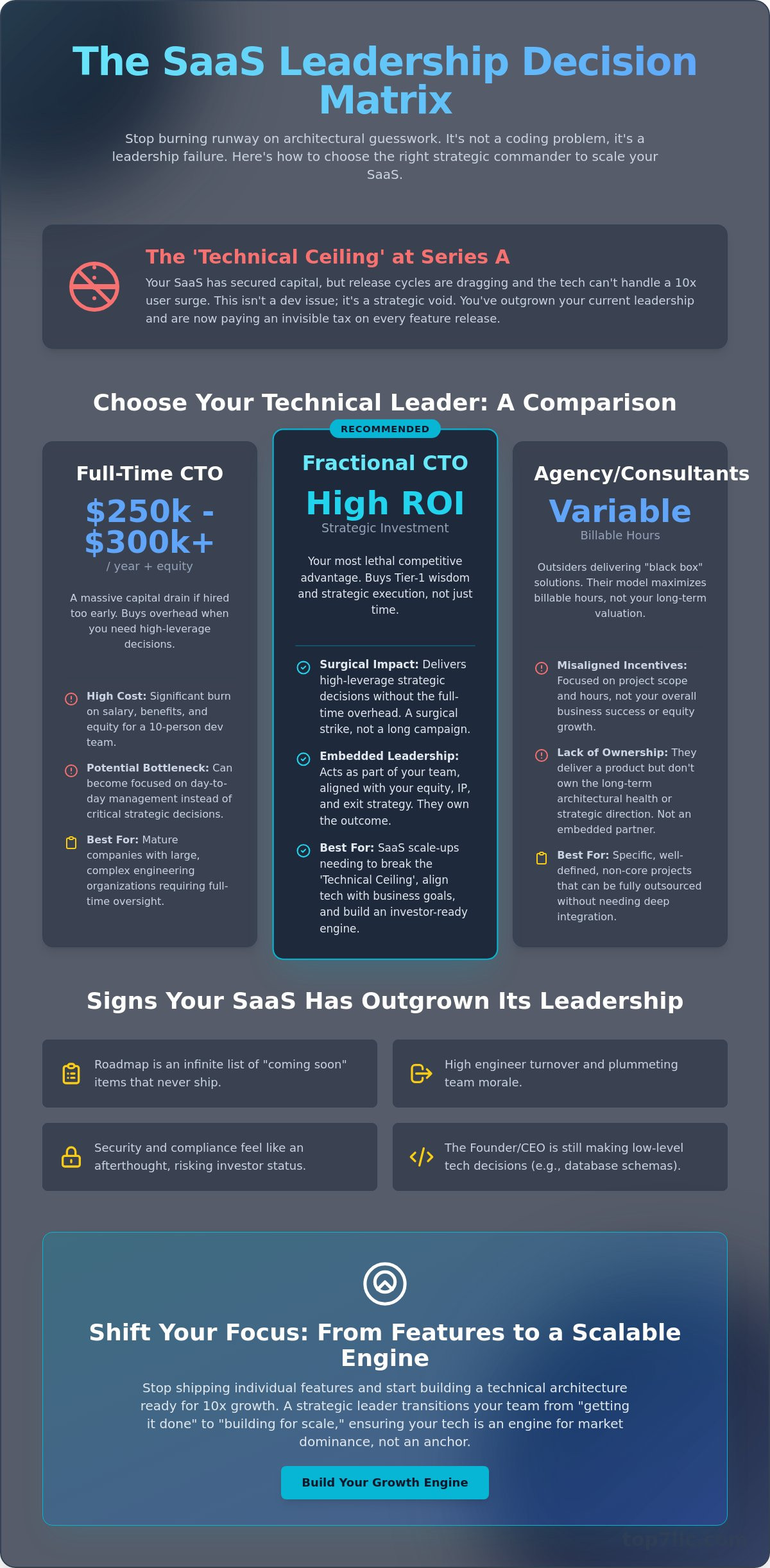
Series A is a graveyard for SaaS companies that refuse to evolve their leadership. You've secured the capital, but your release cycles are suddenly dragging. This is the "Technical Ceiling." It happens because you're missing a Chief Technology Officer (CTO) who thinks in terms of business outcomes, not just lines of code. Your current team is likely drowning in tactical fixes while your strategic growth sits on the shelf.
A fractional cto for SaaS companies provides surgical, high-impact leadership without the bloat of a $300k executive salary. Most founders are stuck in the "Founder's Trap." They try to oversee every pull request while their competitors out-execute them on the business front. If you're still the one deciding on database schemas or server configurations, you aren't being a CEO. You're an expensive bottleneck. You need to step back so your product can step up.
To better understand how this leadership shift aligns technology with your bottom line, watch this breakdown:
Operational friction is the invisible tax you pay on every feature release. By 2026, with the global SaaS market projected to hit $466 billion, your tech stack must be an engine, not an anchor. If your architecture can't handle a 10x surge in users tomorrow, you don't have a viable product; you have a ticking time bomb. A fractional leader identifies these friction points before they bankrupt your runway.
The Difference Between Coding and Technical Strategy
Your lead developer might be a wizard at Python, but that doesn't make them a strategist. Coding is about "how." Strategy is about "why." Too many teams spend months building robust features that the market doesn't actually want to buy. A fractional cto for SaaS companies stops this waste. They transition your team from "getting it done" to "building for scale." They ensure your technical debt is managed like a strategic loan, not a high-interest credit card that's about to max out.
Signs Your SaaS Has Outgrown Its Current Leadership
Watch for the red flags. If your roadmap has become an infinite list of "coming soon" items that never arrive, you have a leadership problem. High engineer turnover and plummeting morale usually mean the team is tired of patching a house of cards. When your security protocols feel like an afterthought, you aren't just risking a data breach. You're risking your entire investor-ready status. Scalability requires a disciplined, operative mindset that your current "move fast and break things" approach can no longer provide.
Fractional CTO vs. Full-Time vs. Agency: The SaaS Decision Matrix
Are you ready to set $300,000 on fire? That's exactly what happens when a mid-market SaaS company hires a full-time CTO too early. Most founders think they're buying stability. In reality, they're buying overhead. You don't need a 40 hour a week executive to manage a 10 person engineering team. You need high leverage decisions that stick. This is where the fractional cto for SaaS companies becomes your most lethal competitive advantage. It's about buying wisdom, not just time.
Agencies are the other extreme. They sell you "solutions" but deliver black boxes. Their business model relies on maximizing billable hours, not your long-term valuation. A fractional leader isn't an outsider looking in; they are an embedded part of your leadership team. They care about your equity, your technical IP, and your exit strategy. If you're currently juggling multiple vendors without a clear internal vision, you aren't leading. You're just paying for someone else's overhead. You need a partner who owns the outcome, not just the ticket count.
Interim leadership serves as a bridge, but fractional expertise is a surgical strike. You're getting Tier-1 talent, the kind of people who have navigated 10x growth and multiple exits, at a Tier-3 price point. Why pay for the learning curve of a junior when you can rent the wisdom of a veteran? It's about making three right decisions a week instead of fifty wrong ones. If you want to stop guessing and start executing, exploring strategic planning through fractional leadership is the only logical move for a scaling company.
Cost-Benefit Analysis of Part-Time Executive Leadership
The "Total Cost of Ownership" for a full-time C-suite hire is staggering. It's not just the $250k base salary. It's the 1-2% equity stake, the benefits, the bonuses, and the massive risk if they don't fit the culture. Fractional roles preserve your runway by converting a massive fixed cost into a flexible, results-oriented investment. We call this the "Fractional Multiplier." Ten hours of a veteran's time will always outperform 40 hours of a mid-level manager trying to "figure it out" on your dime.
Evaluating the Agency Model for SaaS Development
Relying on an agency without internal technical leadership is like hiring a contractor to build your house without an architect. You'll get a house, but the plumbing might be a nightmare. You need an advocate who understands the code but speaks the language of the board. Without this, you're "renting" your technical IP. A fractional leader ensures that the knowledge stays inside your company, building a scalable SaaS engine that investors will actually want to buy. Don't let an agency's transactional incentives dictate your product's strategic future.
The Velocity-7 Framework: Transforming SaaS Friction into Flow
Most "Agile" shops are just running in circles. It's a theatre of productivity that produces zero market advantage. You're shipping code, sure. But are you shipping revenue? That's the question your board is asking. A fractional cto for SaaS companies doesn't just manage tickets; they install a high-performance engine. This is why we rely on the Velocity-7 Adaptive Framework. It's not another generic project management methodology. It's a system designed to align your technical output with your business's aggressive growth targets.
Growth isn't a single lane. It requires absolute synchronization across seven dimensions, including technical architecture, sales operations, and financial runway. If your engineering team doesn't understand your 2026 revenue goals, they're building the wrong product. Top7 professionals don't sit in ivory towers offering "advice." We embed directly into your team, taking ownership of the complex scaling problems that your lead developer is too buried in the weeds to see. We don't just consult; we execute.
From Operational Friction to Efficient Flow
Look at your release cycles. If they're getting longer as your team gets bigger, you've hit a wall. This operational friction is a silent killer of SaaS valuations. We implement agile-based transformations that provide executive-level visibility into every sprint. You'll finally know exactly where your capital is going. Velocity-7 is a proprietary tool designed to create and sustain unstoppable organizational momentum. By identifying and removing bottlenecks in the development lifecycle, we turn your engineering department from a cost center into a growth lever.
Strategic Tech Leadership as a Growth Lever
Your technical roadmap must be a mirror of your revenue targets. Many founders make the mistake of choosing between fixing legacy debt and shipping new features. It's a false choice. Through disciplined strategic planning, we show you how to modernize your systems without halting your product's evolution. This isn't about chasing the latest tech trends. It's about using technology as a weapon to gain market share. Our professionals use the Velocity-7 framework to drive a measurable ROI, ensuring that every architectural decision supports a 10x surge in user demand.
Hiring a Fractional CTO: The SaaS Founder's Evaluation Checklist
Stop hiring for syntax. If you're vetting a candidate based on their knowledge of React versus Vue, you've already lost. A fractional cto for SaaS companies must be a business strategist first and a technologist second. You need someone who understands that a feature release is meaningless if it doesn't move the needle on your MRR. Look for "SaaS DNA", specifically people who have lived through the chaos of scaling a product from 1 to 100. They shouldn't just know how to build; they should know what to kill to keep the engine lean.
A real leader presents a 90-day roadmap on day one. Month one is an audit of your technical debt and team bottlenecks. Month two focuses on architectural alignment with your sales targets. Month three is about measurable velocity increase. If your candidate sounds like a glorified project manager focusing on Jira tickets rather than technical due diligence, walk away. You aren't hiring a babysitter for your developers. You're hiring a growth commander who treats your product like a profit center, not a playground.
Ready to secure your technical future and stop the burn? Hire a Fractional CTO who actually understands the battle for market share.
Key Questions for Your Fractional Candidate
Don't let them hide behind jargon. Ask how they handle technical debt while maintaining feature velocity. A veteran will explain the trade-offs in terms of business risk, not just "clean code." Ask about their process for technical due diligence for a Series B round. If they haven't prepped a data room for investors before, they aren't ready for your scale. Finally, demand to know how they align engineering KPIs with sales targets. If the dev team isn't incentivized by the same growth goals as the sales team, you have a structural failure.
Onboarding for Maximum Impact
Speed is everything. Granting access shouldn't take three weeks; it should take three hours. However, you must do this without creating security vulnerabilities. Set clear expectations for the "Monthly Retainer" model immediately. You're paying for high-leverage outcomes, not a set number of hours logged. Integrate your fractional leader into your existing C-suite culture from the first meeting. They need to be in the room where decisions happen, or they'll spend all their time fixing mistakes they could have prevented. This isn't a "plug-in" service. It's a leadership upgrade.
Stop Building Features. Start Building a Scalable SaaS Engine.
Most SaaS companies are just feature factories. They build until they go broke. They mistake activity for progress and code for value. If your product roadmap looks like a grocery list, you aren't building a business; you're just keeping developers busy. Choosing a fractional cto for SaaS companies isn't about filling an empty seat. It's about shifting your entire operational paradigm from tech chaos to strategic clarity. You need an engine that produces profit, not just pull requests.
Top7 is the strategic choice for US-based SaaS companies that are tired of the "scale-up gap." We don't sit on the sidelines. Michael J. DiPiano Jr. and our team of veterans apply the Velocity-7 Framework to the raw reality of your business. We identify the structural rot in your architecture and replace it with a foundation that supports 10x growth. We don't just offer advice. We embed. We execute. We win. It's time to stop playing defense with your technology and start using it as a weapon for market dominance.
The Top7 Difference: Execution-Focused Leadership
We focus exclusively on mid-market SaaS companies in the US because that's where the stakes are highest. Our "Monthly Retainer" model isn't a bill for hours; it's an investment in ongoing strategic guidance. You get Tier-1 leadership that stays in the foxhole with you. We've solved complex tech leadership gaps for organizations that were one bad release away from losing their Series B funding. By keeping the technical IP inside your company and aligning it with your revenue targets, we ensure your SaaS is always investor-ready.
Schedule Your Velocity Audit
You don't have months to figure this out. Your runway is disappearing every day you spend in technical gridlock. A Top7 strategic evaluation is a surgical strike on your current bottlenecks. In under 60 minutes, we identify the specific growth obstacles that are stalling your release cycles and killing your team's morale. We look at your stack, your processes, and your people to find the friction points you've grown blind to. Stop guessing why your engineering team is slow. Get the data, get the strategy, and get back to scaling.
Command Your Technical Future and Outscale the Competition
You've seen the high price of technical stagnation. It isn't just about missed deadlines; it's about losing market share to competitors who move faster and scale smarter. By now, it's clear that a fractional cto for SaaS companies is the bridge between your current bottlenecks and the $466 billion market potential projected for 2026. You've learned how to bypass the "Founder's Trap" and why our proprietary Velocity-7 Adaptive Framework is the only way to achieve true operational flow.
Top7 doesn't just offer advice; we embed directly into your C-suite to drive measurable revenue growth. We specialize in mid-market SaaS scaling across major US tech hubs, ensuring your architecture remains an engine for growth rather than a liability for investors. Stop letting technical debt dictate your roadmap. Take command of your engineering team and turn your product into a high-velocity revenue machine today. Success in this market belongs to those who lead with precision.
Scale your SaaS with a Top7 Fractional CTO
Frequently Asked Questions
What is the typical cost of a Fractional CTO for a SaaS company?
The investment for a fractional cto for SaaS companies is a fraction of a full-time executive's total compensation package. You avoid the heavy burden of six-figure salaries, equity grants, and massive benefits packages that typically drain a startup's runway. This model allows you to convert a massive fixed cost into a flexible, results-driven investment that scales with your needs. You're paying for senior-level wisdom and market-tested strategy without the senior-level burn rate.
How many hours a week does a Fractional CTO usually work?
Most engagements involve five to ten hours per week of high-leverage strategic work. This isn't about filling a timesheet with low-level tasks or attending every stand-up meeting. It's about making the critical decisions that prevent months of wasted development time and architectural rework. We focus on the strategic 20% of technical leadership that drives 80% of your business results, ensuring your engineering team stays aligned with your revenue targets.
Can a Fractional CTO help with our upcoming Series A or B fundraising?
A fractional leader takes command of your technical due diligence to ensure you're investor-ready. We clean up your documentation, secure your infrastructure, and prepare the technical data room that venture capitalists will scrutinize. Having an experienced leader in the room gives investors the confidence that your tech stack can handle a 10x surge in users. We don't just prepare the paperwork; we defend the technical strategy during the pitch.
What is the difference between a Fractional CTO and a Technical Advisor?
Technical advisors offer passive suggestions, while a fractional cto for SaaS companies provides embedded, operative leadership. Advisors tell you what you should do during a monthly phone call; we make sure it actually gets executed within your team. We take ownership of the technical roadmap, team performance, and architectural integrity. If you want a sounding board, hire an advisor. If you want to eliminate technical bottlenecks, hire a fractional leader.
Do I need a Fractional CTO if I already have a VP of Engineering?
You need both if you're serious about scaling beyond a basic product. A VP of Engineering focuses on the tactical execution, people management, and day-to-day delivery within the dev team. A fractional CTO looks outward, aligning your technical architecture with market demands, investor requirements, and long-term business goals. Without this strategic layer, your VPE might build a technically perfect product that fails to meet your 2026 revenue targets.
Does a Fractional CTO actually write code for the product?
A fractional leader rarely writes production code because their value lies in high-level strategy and oversight. If your CTO is buried in a text editor fixing bugs, they aren't looking at your architectural risks or strategic bottlenecks. Their job is to define the "why" and the "how" so your developers can execute with maximum efficiency. We focus on building the scalable engine, not just tightening individual bolts on the assembly line.
How long does a typical Fractional CTO engagement last?
Engagements typically last between six and twelve months, depending on the complexity of your scaling challenges. Some companies use this role as a bridge while they search for a permanent hire, while others keep us as long-term strategic partners. The relationship continues as long as we're driving measurable ROI and removing the operational friction that slows down your release cycles. We exit once your technical leadership is stabilized and self-sustaining.
Can Top7 provide Fractional CTOs for SaaS companies outside of Boston?
Top7 serves SaaS companies across the entire United States, including major tech hubs on both the East and West Coasts. Our team embeds directly into your C-suite culture regardless of your physical headquarters' location. We use the Velocity-7 framework to ensure seamless communication and surgical execution across any distance. Your geographic location isn't a barrier to accessing elite technical leadership and strategic clarity.


Comments