
Fractional CPO Philadelphia: Scaling Product Without the Payroll Friction

Is your product roadmap a strategic asset or just a high-priced wishlist of features that your market doesn't actually want to buy? Most organizations mistake activity for progress, keeping engineering teams buried in tickets while the revenue needle stays frozen. If you're tired of watching your burn rate climb without a corresponding spike in market share, it's time to stop the bleeding. Engaging a fractional CPO isn't just about filling an executive seat. It's about injecting elite, battlefield-tested leadership into your organization to strip away operational friction without the $300,000 salary or equity drain of a full-time hire.
You likely already feel the disconnect between what's being built and what's being sold, yet the daily grind of shipping keeps you from fixing the root cause. We've seen it: brilliant developers building technically perfect solutions for problems that don't exist. This article will show you how to pivot from a feature-factory mindset to an outcome-focused powerhouse. You'll learn how to deploy a product organization that executes with precision, turning your roadmap into a predictable revenue engine.
We'll explore the strategic advantages of fractional leadership and how the Velocity-7 Adaptive Framework transforms product-market fit from a guessing game into a disciplined science. Prepare to move from friction to flow and reclaim your market dominance.
Table of Contents
The Product Leadership Gap: Why Your Roadmap is Stalled
Most mid-market companies are caught in a "Feature Factory" delusion. They ship code faster than ever, yet revenue remains stubbornly flat. This mismatch between engineering output and executive expectations isn't a productivity issue. It's a leadership void. You're likely practicing "hope-based" product management. You hope the next feature sticks. You hope the market responds. Hope is not a strategy for a scaling business. It's a slow leak in your capital. Hiring a junior product manager to fix this is a common mistake. They can manage a backlog, but they can't define a market position. They lack the authority to say "no" to bad ideas. This is why the strategic depth of a Fractional executive is no longer optional for growth.
To better understand the tactical shifts required in this role, watch this helpful video:
The Symptoms of Operational Friction
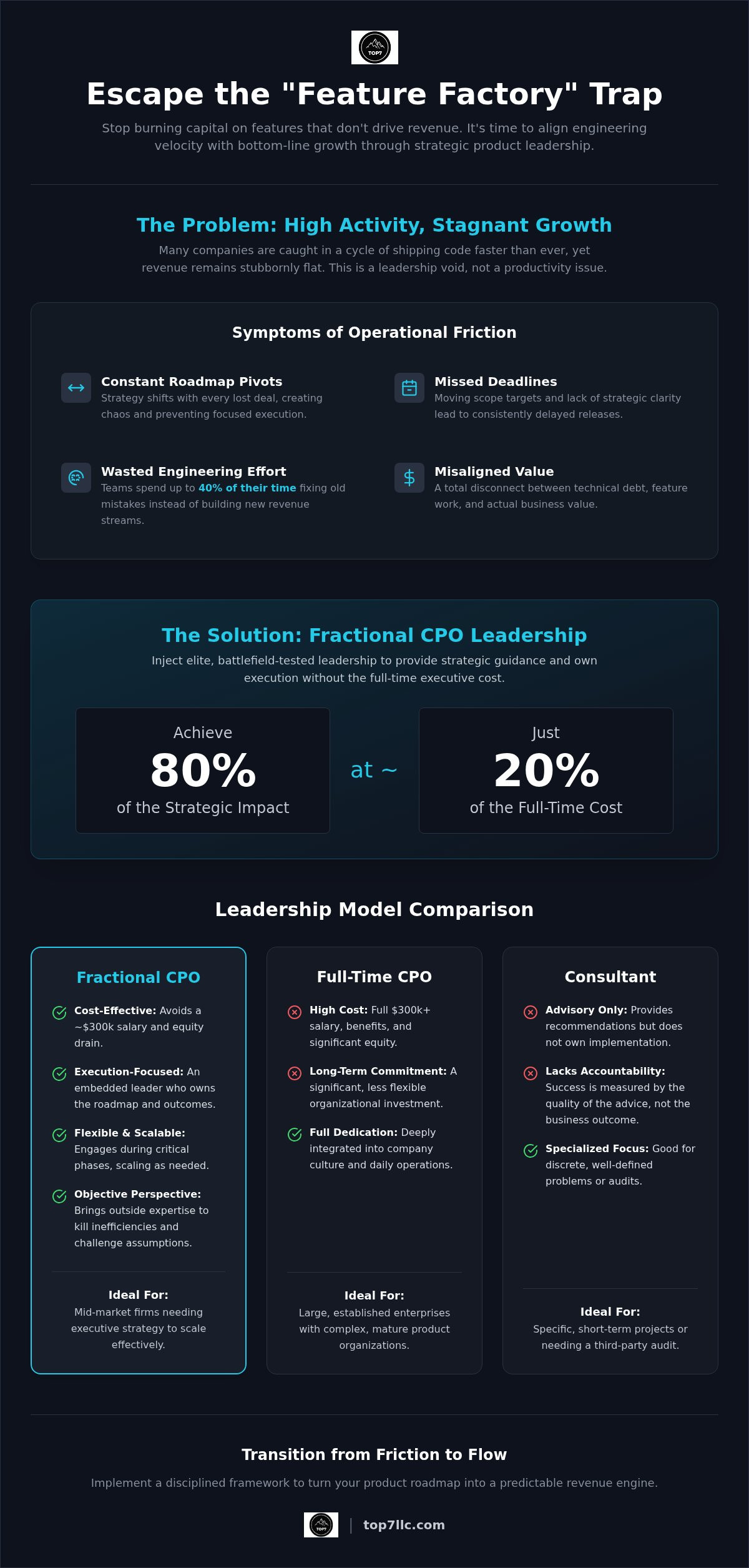
Operational friction is easy to spot if you're honest about your metrics. It shows up as roadmaps that pivot every time a salesperson loses a single deal. It looks like development cycles that consistently miss deadlines because scope is a moving target. Most dangerously, it manifests as a total disconnect between technical debt and business value. Your team spends 40% of their time fixing old mistakes instead of building new revenue streams. Engaging a fractional cpo philadelphia provides the outside perspective needed to kill these inefficiencies before they become cultural norms. Stop letting your engineering budget disappear into a black hole of unvalidated features.
The Executive Burnout Cycle
Founders often play the part of the Chief Product Officer by default. It's a recipe for burnout and strategic blindness. You're too close to the vision to see the operational rot. Similarly, the "accidental CPO", the promoted lead engineer, is often a liability. They understand how things work, but they rarely understand why things sell. They focus on the "how" while the "why" drifts away from actual customer needs. This leadership gap acts as a permanent bottleneck that prevents your organization from scaling nationally. You need a leader who prioritizes profit over pixels and execution over excuses. Success requires a bridge between technical capacity and market demand that your current structure simply doesn't support.
Beyond the Feature List: The ROI of Fractional Product Leadership
Stop measuring your product's success by the number of features shipped. Shipping is easy. Building something that people actually pay for is the hard part. A Fractional CPO is an embedded executive who provides high-level strategic guidance without the bloat of a full-time executive payroll. They don't just advise from the sidelines. They integrate into your team to shift the conversation from "what are we building" to "why are we building it." This distinction is the difference between a profitable venture and a failed experiment.
For most mid-market companies, a fractional cpo philadelphia provides 80% of the strategic impact at about 20% of the cost. You get elite leadership during the critical phases of your lifecycle, with the flexibility to scale that involvement up or down as your needs evolve. Why pay for a $300,000 salary plus equity when you only need ten hours of genius-level strategy per week? It's about buying results, not just hours on a clock.
Strategic Product Management vs. Tactical Execution
Junior product managers are great at ticket grooming and sprint planning. They are tactical soldiers. But they rarely have the authority or the business acumen to drive a product-market fit strategy. A Fractional CPO brings a revenue-first mindset to your technical organization. They manage cross-functional stakeholders, ensuring that Sales, Marketing, and Finance are all reading from the same roadmap. This alignment prevents the "feature creep" that usually occurs when different departments pull the product in conflicting directions. If your roadmap looks like a compromise rather than a strategy, it's time to look into Fractional CPO leadership to restore order.
Measuring the Impact of Fractional Leadership
Real leadership is measured in numbers, not sentiments. When an elite product leader enters the room, you should see an immediate improvement in time-to-value and a measurable reduction in customer acquisition cost (CAC). They tackle churn by identifying exactly where the product fails the user. Perhaps most importantly, an external leader provides an unbiased view of your internal "sacred cows." They don't have the emotional baggage that keeps founders attached to failing features. The Fractional CPO serves as the architect of product-led growth, ensuring every line of code written is a line of code that drives revenue.
The Buying Guide: Fractional CPO vs. Full-Time vs. Consulting
Hiring a full-time Chief Product Officer at a $300,000 base salary plus equity is often a vanity move for mid-market firms. It's an expensive, high-risk bet that usually ends in a messy divorce before the first year is up. Smart organizations are moving away from this traditional model. They realize that a fractional cpo philadelphia can provide the same strategic heavy lifting without the long-term payroll friction. You aren't just saving money; you're buying a faster path to revenue-focused growth.
The difference between a consultant and a fractional leader is ownership. Consultants tell you what to do; they produce reports and slide decks that collect dust. A Fractional CPO stays to execute the vision. They embed themselves in your team, take responsibility for the outcomes, and navigate the internal politics that consultants ignore. Don't fall into the "Interim" trap either. A temporary full-time hire is often just a seat-warmer waiting for their next big corporate role. You need an architect, not a babysitter.
When to Hire a Fractional CPO
You'll know it's time when your product complexity starts to outpace the founder's bandwidth. This usually happens during post-Series A or B growth phases. If you're in a pivot period where you need to re-establish market-fit, you can't afford a learning curve. You need someone who has seen this movie before. When operational friction stops being a nuisance and starts preventing the launch of key revenue streams, your leadership gap has become a liability. Waiting longer only increases the cost of your eventually inevitable correction.
Avoiding the "Consultant" Stigma
Consultants are outsiders; fractional leaders are partners. The hallmark of a true fractional executive is their ability to embed directly into the existing technical and business teams. They don't operate in a vacuum. They manage the daily friction between Sales and Engineering while keeping everyone aligned with the Velocity-7 Adaptive Framework. Retainer-based models ensure they are invested in your long-term success, unlike project-based consulting where the incentive is to bill hours rather than deliver results. Look for a partner who owns the KPIs as if they were their own.
Executing with the Velocity-7 Adaptive Framework
Standard roadmapping tools are useless if the underlying organization is broken. Most companies drown in "Operational Friction," where every decision requires a committee and every sprint is a compromise. The Velocity-7 Adaptive Framework is the proprietary engine used to move organizations from friction to efficient flow. It doesn't just manage tasks; it aligns the seven critical dimensions of your business to ensure that every product decision is backed by financial strategy. This isn't just about shipping code; it's about shipping profit.
When you engage a fractional cpo philadelphia, you aren't getting a passive observer. You're getting a leader who uses this framework to integrate your product roadmap with your P&L. By the end of the first 90 days, the transformation is undeniable. The first 30 days are a tactical hunt for waste and misalignment. Days 31 through 60 focus on rebuilding the communication bridges between Sales, Marketing, and Engineering. By day 90, the organization is executing with a velocity that your competitors cannot match.
Agile Transformation Beyond the Tech Team
Agile shouldn't be trapped in Jira. True agility requires applying these principles to your entire business strategy. The Velocity-7 framework breaks down the silos that typically isolate executive leadership from the realities of the development floor. When your Sales team understands the product roadmap and your Engineering team understands the revenue goals, time-to-market accelerates naturally. You stop building features that the market doesn't want and start dominating your niche through strategic alignment.
Solving Complex Problems with Embedded Leadership
Embedded leadership means auditing the broken processes that full-time hires often ignore to protect their job security. Because the framework is adaptive, it scales to the unique needs of mid-market companies rather than forcing a "one-size-fits-all" corporate template. This methodology transforms product debt into revenue equity by ruthlessly prioritizing outcomes over activity. If you're ready to stop the feature-factory cycle and start driving real growth, you can implement the Velocity-7 Adaptive Framework and start scaling with precision today.
Strategic Product Leadership: Your Next Move
Every month you spend "figuring it out" is a month your competitors spend eating your lunch. Market share isn't static. It's a zero-sum game, and if you aren't aggressively expanding your product-market fit, you're retreating. The cost of a leadership gap isn't just a missed feature or a delayed launch; it's the compounding loss of revenue velocity that your organization might never recover. For the results-oriented CEO, a fractional cpo philadelphia is the surgical tool needed to remove the tumors of indecision and operational drag that are currently stalling your growth.
Top7 is the logical choice for mid-market leaders who have no patience for the "feature factory" cycle. We don't just fill a seat. We redefine the category you play in. We move you from a state of constant reaction to a position of strategic dominance. This transition from "managing" to "leading" is what separates the companies that survive from the companies that scale. If you're tired of watching your burn rate climb while your market share stays flat, the solution isn't more developers. It's better leadership.
The Audit: Identifying Your Growth Obstacles
A Top7 executive doesn't waste time on pleasantries or month-long discovery phases. Within the first 48 hours, we conduct a "Friction Audit" to find exactly where your revenue is leaking. We look at the delta between your engineering spend and your actual customer acquisition numbers. We identify the silos where information goes to die and the "sacred cow" features that are sucking the life out of your roadmap. Preparing your team for this integration requires transparency. They need to understand that the goal isn't to work harder, but to work on things that actually drive profit.
Getting Started: From Friction to Flow
The onboarding process for an elite product leader is designed for immediate impact. We don't believe in long-term strategic plans that collect dust on a shelf. Within the first 30 days, we set immediate "quick win" objectives to prove the framework's value. This might involve killing a zombie project that has drained resources for months or realigning the sales pitch with the actual product capacity. We transform your product debt into revenue equity by ruthlessly prioritizing outcomes over activity. If you're ready to stop the friction and start the flow, you can schedule a strategy call with a Top7 executive to initiate your organizational audit today.
Stop Shipping Features and Start Driving Revenue
Continuing to ship features that don't move your revenue needle is a form of organizational suicide. You've seen how the gap in product leadership creates friction that slows your time-to-market and drains your capital. By integrating a fractional cpo philadelphia, you gain access to seasoned C-suite professionals who prioritize profit over pixels. Our results-oriented, no-fluff methodology replaces "hope-based" management with a predictable engine for growth. You don't need more developers; you need a strategic architect who owns the outcome.
The transition from friction to flow isn't a creative exercise; it's a structural necessity. We use the proprietary Velocity-7 Adaptive Framework to align your technical output with your business goals. This is about battlefield-tested execution that strips away the bloat of traditional consulting. Don't let your competition outpace you while you're stuck in the "feature factory" trap. It's time to audit your obstacles and execute with precision. Schedule a strategy call with a Top7 executive to see how we can turn your product roadmap into a revenue-generating asset. Your market is waiting for leadership. Let's provide it.
Frequently Asked Questions
What is the difference between a Fractional CPO and a Product Consultant?
Ownership is the primary differentiator. A consultant merely hands over a slide deck and leaves; a Fractional CPO embeds into your team to execute the strategy. They take responsibility for the P&L impact of the roadmap and manage the daily friction between departments. You aren't paying for a document; you're paying for a measurable shift in your product's market performance and technical execution.
How many hours a week does a Fractional CPO typically work?
Most engagements range from 10 to 20 hours per week, but the focus is on strategic impact rather than punching a clock. Engaging a fractional cpo philadelphia provides the executive-level oversight your organization lacks without the $300,000 payroll friction. The goal is to provide enough leadership to eliminate operational friction and ensure your engineering team is building features that actually drive revenue, not just clearing tickets.
Can a Fractional CPO help with product-market fit strategy?
Absolutely. Re-establishing or scaling product-market fit is a core function of fractional leadership. We move your organization beyond the "feature factory" trap by analyzing market demand against technical capacity. By using an objective, external perspective, a Fractional CPO identifies why your current roadmap isn't moving the needle and pivots the strategy toward high-value, revenue-focused growth that resonates with your target audience and drives market share.
Will a Fractional CPO manage my existing development team?
Yes, they function as a direct bridge between your executive suite and your technical staff. Instead of having a founder struggle with product management, the Fractional CPO provides professional leadership. They break down silos between engineering, sales, and marketing. This ensures that every sprint is aligned with the company's financial strategy, turning your technical organization into a high-performing execution engine that delivers results with velocity.
How does the Velocity-7 framework apply to product management?
The Velocity-7 Adaptive Framework aligns seven critical dimensions of your business to move you from friction to flow. In product management, this means integrating financial strategy with technical execution. It ensures that your roadmap isn't just a list of creative ideas but a disciplined plan for profit maximization. We audit your existing processes to transform product debt into revenue equity, accelerating your time-to-market through agile-based transformation.
What is the typical length of a Fractional CPO engagement?
Engagement lengths are flexible but typically last between six and eighteen months depending on the complexity of your growth obstacles. Some organizations require a short-term strategic pivot, while others need long-term leadership to build a high-performing product culture. The focus is always on achieving specific, 30-day "quick wins" while building a sustainable, revenue-aligned roadmap that allows your company to scale without the friction of a full-time hire.
Is a Fractional CPO cost-effective for a mid-market company?
For a mid-market company, a fractional cpo philadelphia is the only logical choice for scaling. You get 80% of the strategic impact of a full-time executive at a fraction of the cost. There is no equity drain, no expensive benefits package, and no long-term payroll commitment. It allows you to inject elite product leadership into your organization exactly when you need it, ensuring your capital is spent on growth.
How do you measure the success of a fractional leadership engagement?
Success is measured by the nyers üzleti valóság: revenue growth, customer acquisition cost (CAC) reduction, and churn. We look at time-to-value metrics to see how quickly your team can turn an idea into a profitable feature. If the roadmap isn't driving a measurable spike in market share or profitability, the strategy isn't working. We focus on hard data and profit maximization, not soft sentiments or activity metrics that don't impact the bottom line.


Comments