
Fractional CIO vs. CTO: Which Strategic Leader Does Your Business Actually Need in 2026?
- Robert Fitzgerald
- Jun 5
- 12 min read

Stop hiring for a title and start hiring for your specific bottleneck. With 25% of US businesses already utilizing fractional hiring, the question isn't whether the model works, but which specific role will actually fix your leak. Most CEOs treat technology like a black box that consumes budget without producing ROI, yet they still struggle to settle the fractional cio vs cto debate. You feel the friction every day. Your internal systems are a mess, or your product development is moving at a glacial pace while market opportunities vanish. You need high-level leadership, but the massive overhead of a full-time executive is a luxury your margins can't justify.
It's time to stop guessing and start scaling. You don't need a bloated payroll; you need a tactical strike on the leadership gap stalling your operational flow. This guide breaks down the raw business reality of the fractional cio vs cto choice for 2026. We'll define exactly which role fixes your specific friction and provide a roadmap to hiring elite fractional leadership without the full-time baggage. By the end, you'll know whether you need a strategist to tune your internal engine or a visionary to build a faster vehicle for the market.
Key Takeaways
Identify the core difference in the fractional cio vs cto debate by diagnosing whether your primary bottleneck is internal infrastructure or external revenue-generating innovation.
Stop the $300k+ salary drain; understand how 20% of a veteran's time delivers higher strategic ROI than a full-time, mid-level manager.
Apply the "Mirror Test" to expose whether your technical debt is an internal operational failure or a customer-facing product delay.
Eliminate leadership mismatch by ensuring you don't put an "Optimizer" in an innovation role or a "Builder" in a maintenance position.
Implement a 90-day roadmap using the Velocity-7 Adaptive Framework to turn technology from a budget-consuming black box into a precision scaling tool.
Table of Contents
The Strategic Divide: Internal Systems (CIO) vs. External Innovation (CTO)
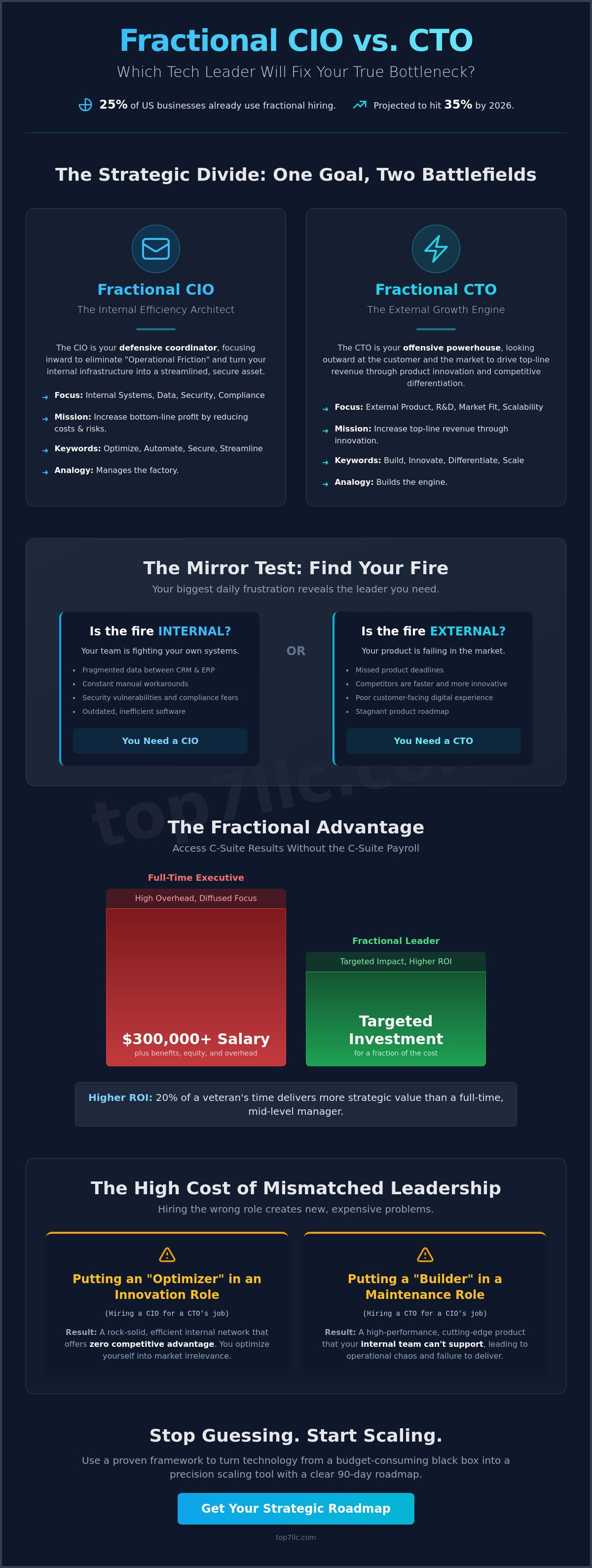
Stop treating technology like a generic utility. Many mid-market firms in competitive hubs like Boston or Chicago make the fatal mistake of using "CIO" and "CTO" interchangeably. They aren't the same. One builds the engine; the other manages the factory. If you confuse the two, you'll end up with a high-performance product that your internal team can't support, or a rock-solid internal network that offers zero competitive advantage. This is the "Black Box" problem where technology consumes your budget without a clear ROI. In the fractional cio vs cto debate, the winner is whichever leader solves your specific bottleneck.
For 2026 growth, high-level tech leadership is non-negotiable. You can't scale a modern business on a foundation of "good enough" IT or stagnant product development. Data from 2024 showed that 25% of US businesses already utilized fractional hiring, and that number is projected to hit 35% by 2026. The market is moving toward specialized, agile leadership. If you're still guessing which role you need, you're already falling behind the competition in Tier 1 markets. You need a strategist who can translate technical complexity into measurable profit.
To better understand how these roles impact your bottom line, watch this breakdown of tech leadership ROI:
The CIO: Your Internal Efficiency Architect
The Chief Information Officer is your defensive coordinator. Their mission is to eliminate "Operational Friction," the invisible drag caused by outdated ERP systems, fragmented data flows, and manual workarounds. A fractional CIO doesn't just manage your help desk. They architect a system where data moves through your organization without human intervention. They focus on the bottom line by reducing technical debt and ensuring your US-based operations are secure and compliant. If your staff is fighting your software instead of using it to win, your bottleneck is internal. You need a CIO to turn your infrastructure into a streamlined asset rather than a liability.
The CTO: Your External Growth Engine
The Chief Technology Officer (CTO) is your offensive powerhouse. While the CIO looks inward at the business, the CTO looks outward at the customer and the market. They lead R&D and define the product-market fit for your technology offerings. Their job is driving the top line through innovation and competitive differentiation. They align your tech stack with customer expectations to ensure you aren't building yesterday's solutions for tomorrow's problems. If you need to ship a revenue-generating product or gain a technical edge over your rivals, the fractional cio vs cto choice is clear. You need a CTO to build the vehicle that carries your brand to market dominance.
CIO vs. CTO Decision Framework: Identifying Your Bottleneck
Stop guessing. The choice between a fractional cio vs cto isn't a coin flip; it's a diagnostic process. You need to apply the Mirror Test. Look at your daily operations. Is your biggest fire burning inside your walls or in the hands of your customers? If your staff spends hours fighting an ERP that doesn't communicate with your CRM, you have an internal systems crisis. If your product roadmap is a graveyard of missed deadlines while competitors eat your market share with slicker digital experiences, you have an innovation crisis. You can't fix a broken engine with a new coat of paint.
The Velocity-7 Adaptive Framework cuts through the noise by identifying whether your growth is stalled by operational friction or a lack of market-facing velocity. Your geographic context also dictates your priority. An Austin-based tech hub startup lives or dies by its innovation pipeline, making a CTO essential. Conversely, a Midwest manufacturing firm might need a CIO to automate the shop floor and secure the supply chain against rising 2026 cyber threats. The rise of The Fractional CIO & CTO Revolution proves that smart companies are finally prioritizing specialized expertise over generic, full-time management. If you're ready to stop the bleeding, identifying your specific leadership gap through Strategic Planning is the only way forward.
When to Prioritize a Fractional CIO
Choose a CIO when your internal world is chaotic. If your team is drowning in fragmented data and siloed tools, your efficiency is leaking profit. You need an architect to streamline the "Operational Friction" of your internal IT. With cybersecurity accountability now a top board priority in 2026, a CIO ensures your data security and compliance aren't just checkboxes but competitive advantages. They allow you to scale operations without a proportional, expensive increase in headcount. They focus on the bottom line by killing technical debt before it kills your margins.
When to Prioritize a Fractional CTO
Choose a CTO when your external growth has hit a ceiling. If your product roadmap is stalled or failing to meet shifting market demands, your revenue is at risk. Research shows a fractional CTO can increase engineering output by 30 to 60 percent, providing the high-level R&D leadership needed to stay ahead. They are essential if you're transitioning from a service-based model to a tech-enabled one. When competitors are out-innovating you, the CTO aligns your tech stack with customer expectations to drive the top line through pure innovation.
Fractional Leadership: Accessing C-Suite Results Without the Payroll
Stop paying for overhead when you only need expertise. In the fractional cio vs cto landscape, the most expensive mistake you can make is hiring a full-time, mid-level manager to do an executive's job just because they're affordable. You end up with a "yes-man" who lacks the strategic depth to move the needle. A fractional leader provides 20% of a veteran's time, which consistently outperforms 100% of a junior's effort. You're buying the results, not the desk space. This model allows you to secure East Coast-level expertise from hubs like New York or Boston without the crushing $300,000+ salary trap that 2026 market rates demand.
The difference between a consultant and a fractional leader is simple: execution. Consultants talk and leave you with a PDF. Fractional leaders embed directly into your team and own the outcome. They aren't outside observers; they're temporary pillars of your C-suite. They identify the specific leadership gap stalling your operational flow and fix it. Whether you need to secure your data or ship a new product, you're getting a leader who has seen your specific problem ten times before in different industries. That "portfolio perspective" is a shortcut to growth that a permanent hire simply can't offer.
The Financial Logic for Mid-Market Companies
The math is undeniable. The true employer cost for a full-time CIO in 2026, including benefits and payroll taxes, sits between $270,000 and $320,000. For CTOs, total compensation including equity can exceed $600,000. Most mid-market firms don't need that level of expense on their books 40 hours a week. By using a fractional model, you eliminate the "onboarding lag" and the massive recruiter fees. You can redirect that saved capital into actual technology and product development, turning a fixed salary expense into a dynamic growth investment. You get the brainpower without the permanent baggage.
Strategic Velocity: Moving from Friction to Flow
Flexibility is the ultimate competitive advantage in the 2026 economy. Fractional leaders use agile-based transformation to accelerate results, moving your business from operational friction to efficient flow. They don't just maintain; they transform. By applying lessons learned across multiple sectors, they bring a high-velocity approach to problem-solving. This isn't about "trying" to improve; it's about precision execution. When you hire a Fractional CTO or CIO, you're choosing strategic speed over administrative bloat. You're choosing to win the market share struggle while your competitors are still writing job descriptions.
The High Cost of Mismatched Leadership
Hiring the wrong persona is strategic suicide. In the fractional cio vs cto debate, most CEOs focus on the price tag and ignore the psychological profile of the leader they're bringing in. Putting a "Builder" (CTO) into an "Optimizer" (CIO) role is like asking a race car driver to manage a municipal bus fleet. They'll over-engineer your internal systems. They'll choose the shiniest new tech stack when you just needed a stable ERP. They'll prioritize performance over the reliability your staff needs to function. The result? A complex, expensive mess that nobody knows how to use.
The cost of this mismatch is staggering. Research indicates the average cost of a bad engineering hire is already $100,000 to $150,000. Imagine the damage of a bad executive hire. Mismatched leadership creates "Operational Friction" that doesn't just waste money; it kills the morale of your best talent. When your "Operator" CIO stifles product creativity because of a misplaced fear of risk, your innovators leave for the competition. You're left with a stable, secure, and completely irrelevant company. You don't just lose revenue; you lose your market position.
Case Study: The Product That Never Launched
Consider a mid-market firm that tried to pivot from consulting to a tech-enabled subscription model. Instead of a Fractional CTO, they let their internal-focused IT Director lead the project. He focused on server redundancy and SOC2 compliance before they even had a working prototype. The result? Six months of wasted dev hours and zero customer-facing features. A Fractional CTO would have prioritized the MVP and product-market fit. They would have pivoted the strategy toward revenue first. Aligning the leadership persona with your business goal is the difference between a successful launch and a graveyard of "what-ifs."
Why "Good Enough" Tech Leadership is a Growth Killer
Settling for "Good Enough" is a growth killer. Letting an IT Manager play the role of a CIO might save you a few thousand dollars today. It creates strategic gaps that will be insurmountable by 2027. You don't need a manager to watch the servers. You need a leader who understands the 2026 technical landscape. Strategic errors in tech leadership compound like debt. By the time you realize you have the wrong person, your competitors have already automated your market share away. Stop guessing. Audit your current tech leadership with Top7 to see where your friction is hiding and eliminate it before it becomes fatal.
Deploying the Velocity-7 Framework with Fractional Leadership
Stop treating tech leadership as a luxury hire. It's a precision instrument. Most businesses fail because they hire for a title but lack a system for execution. This is where the Velocity-7 Adaptive Framework changes the game. Whether your diagnostic points toward a fractional cio vs cto, the framework ensures that leadership translates into measurable profit. We don't believe in long-term "discovery" phases that lead nowhere. We believe in high-velocity transformation. Our executives embed directly into your culture, not as outsiders, but as owners of your technical success. They solve complex problems by looking at the 7 dimensions of growth, recognizing that in 2026, technology is the strategic foundation for every single one of them.
You can't scale on a fractured foundation. The Velocity-7 approach is designed to move your organization from operational friction to efficient flow in exactly 90 days. We don't just identify the gaps; we close them with tactical precision. By the time most companies realize their tech stack is a liability, our partners are already using theirs as a weapon for market share. If you're still debating the fractional cio vs cto choice without a proprietary methodology to back it up, you're just guessing with your shareholders' money. You need a battle-tested protocol that guarantees results.
The 90-Day Roadmap to Tech Dominance
Success isn't accidental; it's engineered. Our roadmap follows three distinct, high-impact phases:
Phase 1: Diagnostic and friction point identification. We strip away the corporate jargon to see the raw operational reality. We find exactly where your budget is leaking and where your processes are stalling.
Phase 2: Strategic alignment and roadmap development. We build the vehicle or tune the engine. This phase ensures your technology roadmap is perfectly synced with your 2026 revenue goals.
Phase 3: Agile execution and measurable ROI tracking. We execute. We don't just provide a PDF; we ship code, secure networks, and streamline data flows. We prove the value in the numbers, not the promises.
Ready to Scale? Your Next Move
Market leaders in Dallas, Boston, and Florida are already choosing Top7 because they're tired of the "consultant" runaround. They want results, not excuses. In the 2026 economy, a no-nonsense, results-oriented partnership is the only way to maintain a competitive edge. You don't have time for a six-month onboarding process or a leader who needs their hand held. You need an executive who can hit the ground running and deliver a clear ROI before the first quarter is over. The choice is yours: stay stuck in the friction or move into the flow. Schedule a strategy call with a Top7 executive today and let's identify the specific gap stalling your growth.
Own Your Technical Future
The distinction between a fractional cio vs cto isn't just academic; it's a matter of survival in the 2026 economy. You've seen the raw cost of mismatched leadership and the invisible drag of operational friction. If your internal systems are bleeding cash, you need an architect. If your product is losing market share, you need a visionary. Settling for a mid-level manager when you need a strategist is a shortcut to stagnation. You need a leader who has been in the trenches and knows how to win.
Top7 brings seasoned C-suite professionals with decades of experience directly into your organization. We don't just offer advice; we deploy the proprietary Velocity-7 Adaptive Framework to turn your technology into a scaling machine. Our focus is mid-market growth and killing the friction that stops your flow. The market won't wait for you to find a "perfect" full-time hire while your competitors automate your market share away. Stop the friction and start the flow—Get your Fractional CTO/CIO Roadmap from Top7. It's time to stop guessing and start winning.
Frequently Asked Questions
What is the primary difference between a Fractional CIO and a Fractional CTO?
The primary difference in the fractional cio vs cto debate is the direction of focus. A CIO looks inward to optimize internal systems, data flow, and cybersecurity to eliminate operational friction. A CTO looks outward, driving revenue through product innovation and customer facing technology. One manages the business infrastructure while the other builds the technical products you sell to the market.
Can one person fulfill both the CIO and CTO roles effectively?
While some executives claim to handle both, doing so effectively is rare because the roles require different personas. A CIO is an Optimizer focused on stability and risk management, while a CTO is a Builder focused on innovation and speed. Combining them often leads to strategic neglect in one area, creating a bottleneck that stalls your long term growth.
How much does a Fractional CIO or CTO typically cost compared to a full time hire?
A fractional executive costs significantly less than a full time hire because you aren't paying for a 40 hour week, benefits, or massive equity packages. While total compensation for a full time CTO can exceed $600,000 in 2026, a fractional model allows you to access that same level of elite expertise for a fraction of the overhead. You pay for results, not desk space.
How many hours a week does a fractional tech executive usually work?
Most fractional executives work between 5 and 15 hours per week, depending on the complexity of your specific roadmap. This isn't about punching a clock; it's about high impact strategic execution. They embed into your leadership team to provide the exact amount of guidance needed to move from friction to flow without the bloat of a permanent executive salary.
Is a Fractional CTO better for a startup or an established mid market company?
A Fractional CTO is typically essential for startups that need to ship a product and find market fit quickly. Established mid market companies often prioritize a CIO to fix the technical debt and fragmented systems that prevent efficient scaling. The right choice depends entirely on whether your biggest fire is burning inside your walls or in the hands of your customers.
What industries benefit most from fractional tech leadership in 2026?
Every industry requiring digital transformation benefits, but SaaS, manufacturing, and professional services see the highest ROI. Manufacturing firms use fractional CIOs to automate shop floors and secure supply chains. SaaS companies leverage fractional CTOs to increase engineering output by 30 to 60 percent. If technology is your foundation, fractional leadership is your primary competitive leverage.
How do I know if my business is ready for a fractional executive?
Your business is ready if technology feels like a black box that consumes budget without producing a clear ROI. Other signs include constant operational friction, missed product deadlines, or cybersecurity fears keeping your board awake at night. If your current IT manager is overwhelmed by strategic decisions, you've already outgrown your leadership structure and need executive intervention.
What is the Velocity-7 Adaptive Framework and how does it help?
The Velocity-7 Adaptive Framework is a proprietary methodology designed to move companies from operational friction to efficient flow in 90 days. It focuses on the seven dimensions of growth, ensuring technology serves as a precision tool for scaling. It provides a structured roadmap for fractional leaders to deliver measurable results and strategic dominance without the typical corporate lag or guesswork.


Comments