

Fractional CFO for Private Equity Portfolio: Engineering Velocity & Exit Value
- Robert Fitzgerald
- Jun 23
- 12 min read

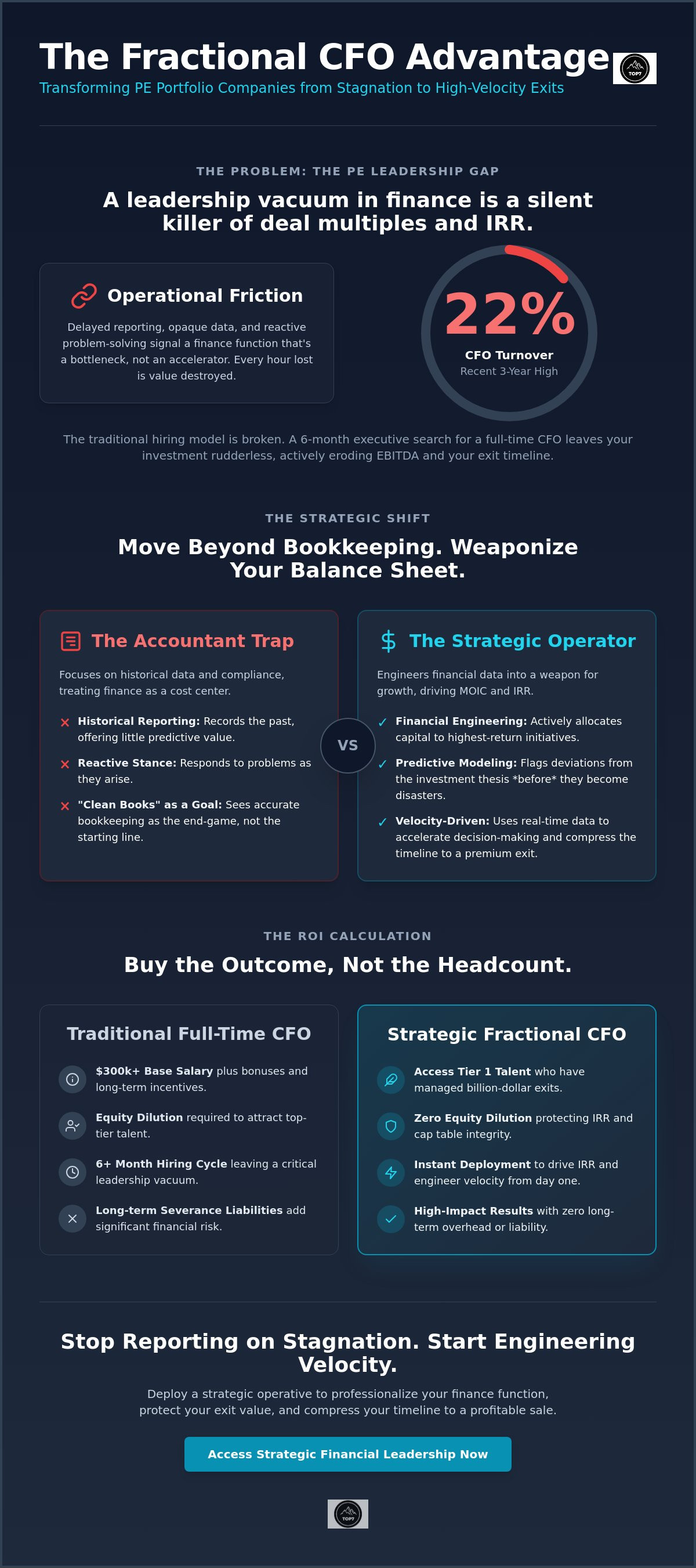
A Chief Financial Officer who only reports on the past isn't an asset; they are a liability that's actively eroding your IRR. If your portfolio companies are bogged down by operational friction and opaque reporting, you're missing the exit window before it even opens. Deploying a fractional cfo for private equity portfolio management isn't just about cutting overhead. It's about installing a strategic operator who treats financial data as a weapon for growth rather than a historical record. With CFO turnover hitting a three-year high of 22% recently, the traditional hiring model is officially broken.
You know the frustration of watching a post-merger integration stall because the books are a mess and the board is flying blind. It's a common trap that kills deal value, and it's one you can't afford in a market that demands precision. This article shows you how to escape that cycle. You'll learn how fractional financial leadership transforms stagnant assets into high-velocity, exit-ready powerhouses. We'll explore how to professionalize the finance function, implement real-time reporting that aligns with the 2026 IPEV Valuation Guidelines, and use a strategic framework to compress your timeline to a profitable exit. It's time to stop reporting on stagnation and start engineering velocity.
Table of Contents
The PE Leadership Gap: Why Your Portfolio Company is Stalling
A leadership vacuum in a portfolio company is a silent killer of deal multiples. Most private equity firms realize too late that their latest acquisition is stalling not because of market conditions, but because of a total lack of strategic financial direction. You don't need someone to just "clean the books." You need a strategic operative embedded to drive IRR and engineer velocity from day one. A fractional cfo for private equity portfolio companies fills this gap instantly, bypassing the catastrophic six-month executive search that leaves your investment rudderless.
To better understand the high-stakes reality of financial leadership in the PE space, watch this helpful video:
Falling into the "Accountant Trap" is a common strategic error. Your current controller might be excellent at tax compliance and monthly closings, but they aren't the strategic partner the board needs to scale. If your financial leadership is a bottleneck in decision-making rather than an accelerator, you're losing money every hour. Operational friction signals are obvious: delayed reporting, lack of real-time visibility, and a finance function that reacts to problems instead of anticipating them. If you can't see the numbers in real-time, you're flying blind into a storm.
The High Price of Executive Vacancy in 2026
In 2026, the speed of capital is faster than ever. Every month you spend without a heavy-hitter in the CFO seat erodes portfolio EBITDA. Recent data shows that CFO turnover reached a three-year high of 22% in 2024, making the hunt for full-time talent a losing game. Delayed decisions on capital allocation or missed operational optimizations don't just slow you down; they actively destroy value. Deploying Interim Leadership acts as a bridge to stability in hyper-competitive hubs like Boston or Austin. It's the difference between merely keeping the lights on and actually accelerating the engine for a premium exit.
Fractional vs. Full-Time: The ROI Calculation
Why pay a $300k+ base salary plus massive bonuses for a full-time executive when you can buy the same Tier 1 talent on a fractional basis? A fractional cfo for private equity portfolio assets eliminates equity dilution and the looming threat of long-term severance liabilities. You get access to seasoned professionals who've managed billion-dollar exits, talent that wouldn't even look at a mid-market company for a full-time role. It's about buying the outcome, not the headcount. Stop hiring for the position and start hiring for the result. Growth doesn't wait for your HR department to find the perfect resume.
Financial Engineering vs. Accounting: Driving MOIC through Data
Clean books aren't a victory; they're the ante to play the game. If your finance team thinks hitting a month-end close by the 15th is a major achievement, you've already lost. In the high-stakes world of private equity, accounting is just a historical record of how you spent money. Real value is created through financial engineering. This is where a fractional cfo for private equity portfolio companies proves their weight in gold. They don't just record the past; they weaponize the balance sheet to drive Multiple on Invested Capital (MOIC).
Strategic capital allocation is the difference between a mediocre 2x and a dominant 5x exit. You need a leader who identifies exactly where every dollar generates the highest return. Are you sitting on excess working capital that could fund a strategic add-on? Is your R&D spend actually yielding a measurable return? Predictive modeling moves the needle from "what happened" to "what will happen." It protects your investment thesis by flagging deviations before they become disasters. If you want to see how this looks in practice, exploring strategic planning services can provide the clarity your board is currently missing.
Cash flow optimization is another area where standard accounting fails. Most controllers focus on the P&L while the balance sheet rots. A fractional leader unlocks internal capital by tightening the cash conversion cycle. They find the "hidden cash" trapped in inefficient accounts receivable or bloated inventory. This isn't just about liquidity; it's about funding growth without further equity dilution or expensive debt. You aren't just managing a company; you're optimizing a financial engine for maximum output.
Building the Board-Ready Reporting Suite
Board-ready reporting isn't about more data; it's about the right data. PE sponsors care about specific KPIs: EBITDA, Cash Conversion, CAC/LTV ratios, Burn Rate, and Net Working Capital. Most mid-market teams can't produce these accurately without weeks of manual spreadsheet labor. Automating a "Single Source of Truth" eliminates the human error that leads to price chips during due diligence. It bridges the communication gap between the CEO's operational vision and the deal team's financial requirements.
Risk Mitigation and Covenant Management
Risk isn't just about insurance policies. It's about proactive debt covenant monitoring. A technical default can trigger a cascade of issues that kill deal velocity and destroy trust with lenders. A seasoned fractional leader treats cybersecurity and financial control audits as value protection, not just compliance checkboxes. They prepare for "Black Swan" events by stress-testing the cash flow model against every possible market contraction. You stay ahead of the curve because you've already modeled the worst-case scenario.
The Velocity-7 Approach to Private Equity Transformation
Traditional consulting is a parasitic drain on your portfolio's EBITDA. You don't need a 50-page slide deck explaining why you're failing; you need a system that fixes it in real-time. This is why we deploy the Velocity-7 Adaptive Framework. It's a proprietary methodology designed to strip away operational friction and replace it with efficient flow. When you bring in a fractional cfo for private equity portfolio management, you aren't just getting a part-time executive. You're installing a transformation engine that applies agile principles to mid-market finance functions.
Agile transformation isn't just for software developers. In a finance context, it means shortening closing cycles, automating reporting pipelines, and creating a feedback loop that informs daily tactical moves. We embed directly with your portfolio team to solve complex growth obstacles that have likely been ignored for years. Our 90-day transformation roadmap is relentless. Month one is about radical transparency and stabilizing the baseline. Month two focuses on process automation and eliminating redundant tasks. By month three, we're shifting focus toward velocity and preparing the asset for its next valuation event.
Breaking the Bottlenecks: A Tactical Execution
Growth stalls when you ignore the "Seven Dimensions of Growth" within your financial structure. We look for operational debt: those "temporary" manual workarounds that have become permanent bottlenecks. For example, when Top7 intervened at a stalled Midwest manufacturing firm, the issue wasn't the product; it was a fractured supply chain finance process that strangled cash flow. By identifying and surgically removing these frictions, we restored liquidity and cleared the path for significant EBITDA expansion within two quarters. We don't just find the leaks; we weld the pipes shut.
Agile Leadership in a High-Stakes Environment
Consulting reports are where good ideas go to die. Fractional leadership succeeds because it uses the "Direct Embed" model. We aren't outside advisors looking in; we're partners in the trenches. This hands-on approach is critical for maintaining momentum across remote or distributed executive teams. We use Advanced Project Management to ensure that every strategic initiative is tracked, measured, and pushed to completion. In a high-stakes PE environment, proximity to the data and the team is the only way to ensure the investment thesis stays on track. Stop paying for advice and start paying for execution.
Mastering the Deal Lifecycle: Due Diligence to Exit
Deal value isn't just negotiated at the table; it's engineered across every phase of the investment lifecycle. Most private equity sponsors wait until an LOI is signed to realize their portfolio company's finance function is a disorganized mess. By then, you're already defending against price chips and deal fatigue. A seasoned fractional cfo for private equity portfolio companies steps in long before the bankers arrive. They ensure the financial narrative is bulletproof, from the initial pre-acquisition audit to the final exit wire transfer.
The First 100 Days are your most critical window for value creation. This is when we professionalize the finance department post-close, replacing "founder-led" chaos with institutional-grade reporting. If the platform strategy includes add-on acquisitions, you need a disciplined M&A execution engine. We manage the pipeline, perform the heavy lifting on buy-side diligence, and ensure every acquisition is accretive from day one. If you want to accelerate this process, deploying an interim leadership team is the fastest way to stabilize the platform and start scaling.
Post-Merger Integration (PMI) without the Chaos
Integration is where synergies go to die. Harmonizing accounting systems and corporate cultures across three different acquisitions isn't a job for a standard controller. It requires an operative who understands how to capture the "1+1=3" math that justifies your entry multiple. Whether you're building a healthcare platform in Dallas or a manufacturing roll-up in Chicago, the fractional CFO ensures that operational integration doesn't stall. We eliminate redundant costs and unify data streams so the board sees one clear, consolidated truth instead of a collection of disparate spreadsheets.
Maximizing the Exit Multiple
Exit readiness starts 12 to 18 months before you actually want to sell. We call this "dressing the bride," but it's really about stress-testing the business for a buyer's scrutiny. We build the "Buyer's Data Room" in advance, ensuring every KPI and EBITDA adjustment is documented and defensible. When the buyer's diligence team starts digging, our numbers stand up to the pressure. This proactive approach prevents the "death by a thousand cuts" that happens when a buyer finds inconsistencies in your reporting. Finally, we ensure a seamless transition for the permanent CFO, leaving the asset in a state of peak professionalization that commands a premium multiple.
Fractional CFO Leadership: High-Stakes Results, Zero Overhead
Hiring a full-time executive in a volatile market is a massive, often unnecessary gamble. You're looking at a base salary that often exceeds $200,000 to $400,000, not including benefits, equity, and the risk of a bad cultural fit. A fractional cfo for private equity portfolio companies slashes that cost by 40% to 60% while delivering immediate, high-stakes results. At Top7, we don't send you junior consultants who are learning on your dime. We deploy seasoned professionals who have managed complex PE exits and understand exactly how to defend a valuation. You get the "been there, done that" experience without the permanent payroll burden.
The real win is the combination of strategic guidance and execution support. Most advisors give you a map but won't help you drive the car. We do both. We identify the strategic levers that increase MOIC and then we stay in the trenches to pull them. Whether it's restructuring debt or professionalizing a messy finance department, we focus on the dirty work that actually moves the needle. This model allows you to scale your leadership team elastically. You get the firepower you need during a transformation or an acquisition spree and can scale back once the ship is stabilized. It's about maximizing output while minimizing the drag on your EBITDA.
Local Expertise, National Reach
PE corridors move at different speeds. Navigating the business climate in Texas requires a different tactical approach than a platform build on the East Coast or the West Coast. Local presence isn't just about time zones; it's about established banking relationships and understanding regional audit requirements. Top7 maintains a footprint in major hubs from Florida to Chicago, ensuring your portfolio companies have leadership that understands the local landscape while executing on a national scale. This regional intelligence is a critical component of our Interim Leadership model. We provide the boots on the ground required to stabilize regional assets quickly.
Stop Guessing, Start Executing
Stop settling for "financial historians" who only tell you why you missed your targets last quarter. If you're tired of reports that don't lead to action, it's time to change the leadership model. A consultant talks; a fractional leader executes. We don't just point out the strategic errors; we fix them. The first step to reclaiming your deal velocity is a diagnostic audit of your portfolio company's current state. It's a no-nonsense assessment of your financial health and operational readiness. Don't let another quarter of stagnant growth erode your returns. Schedule your Velocity-7 diagnostic session with Top7 today and start engineering your exit value.
Stop Bleeding IRR: Engineer Your Exit Velocity Now
Stagnation is a choice. You can continue to let a leadership vacuum or mediocre reporting erode your deal multiples, or you can install the strategic firepower required to win. We've shown how moving beyond basic accounting to true financial engineering transforms a portfolio company from a liability into a high-velocity asset. By deploying a fractional cfo for private equity portfolio assets, you bypass the friction of traditional hiring and get immediate access to Tier 1 talent. This isn't about filling a seat; it's about securing your investment thesis and accelerating your timeline to exit.
Our proprietary Velocity-7 Adaptive Framework isn't just a theory. It's a battle-tested roadmap for results. Whether your assets are located in major PE hubs like Boston, Dallas, or Austin, our seasoned professionals embed directly into your team to solve complex growth obstacles and professionalize the finance function. Don't wait for the next board meeting to address these bottlenecks. It's time to stop reporting on the past and start engineering a premium exit.
Your investors expect dominance, and your portfolio deserves leadership that delivers. Let's get to work.
Frequently Asked Questions
What is the difference between a fractional CFO and a financial consultant?
A fractional CFO is an embedded executive with operational accountability, while a consultant is an outside advisor who delivers a report and leaves. Consultants offer advice; fractional leaders own the execution and the results. When you bring in a fractional leader, they manage your team, make high-stakes decisions, and stay in the trenches until the investment thesis is realized. They don't just tell you what's wrong; they fix it.
How much does a fractional CFO for a private equity portfolio company cost?
The cost structure is typically a monthly retainer or a project-based fee, which is significantly more efficient than a full-time executive salary. On average, a fractional cfo for private equity portfolio companies costs 40% to 60% less than a full-time hire. You eliminate the burden of $300k+ base salaries, bonuses, and equity dilution. You're buying the outcome and the expertise without the permanent overhead of a full-time C-suite payroll.
Can a fractional CFO help with an upcoming M&A transaction?
Yes, they are specialized operatives for the entire deal lifecycle. They lead sell-side due diligence to prevent price chips and organize data rooms to ensure a smooth process. On the buy-side, they manage post-merger integration to capture synergies immediately. Their goal is to protect the deal value and ensure the finance function doesn't become a bottleneck that kills the transaction's momentum or erodes the multiple.
How long does it take to onboard a fractional CFO into a portfolio company?
Onboarding happens in days, not months. While a traditional executive search takes six months to find and hire a candidate, a fractional leader can be on-site and impacting EBITDA within a week. Our Velocity-7 Adaptive Framework allows for rapid stabilization of the finance department. We bypass the "getting to know you" phase and move straight into identifying operational friction and executing the transformation roadmap.
What industries do Top7 fractional CFOs specialize in?
We focus on complex, mid-market business models where financial engineering drives value. This includes manufacturing, healthcare, SaaS, and professional services. We don't just look at the vertical; we look at the mechanics of the business. Whether it's managing supply chain finance in a manufacturing roll-up or optimizing CAC/LTV ratios in a tech platform, we apply battle-tested frameworks that work across any industry with high-growth potential.
Will a fractional CFO manage my existing accounting team?
They absolutely will. A fractional leader takes full ownership of the finance department, mentoring your controller and professionalizing the entire staff. They implement institutional-grade reporting standards and eliminate the manual "spreadsheet chaos" that plagues many founder-led companies. Your team stops being a back-office cost center and starts functioning as a strategic asset that provides the board with real-time, actionable data for better decision-making.
How does a fractional CFO interact with the PE board of directors?
They act as the primary financial liaison between the portfolio company and the sponsors. A fractional cfo for private equity portfolio management delivers board-ready reporting that focuses on the KPIs that actually matter to investors, like debt covenants and cash conversion. They defend the numbers during board meetings and ensure that the CEO’s operational vision remains perfectly aligned with the private equity firm's investment thesis and exit timeline.
What is the typical duration of a fractional CFO engagement in PE?
Engagements are flexible and driven by your specific value creation plan. Some last 6 to 18 months to bridge a leadership gap or manage a specific transformation. Others continue through the entire hold period to ensure the asset remains exit-ready at all times. You scale the engagement up during intensive periods, like an acquisition spree, and scale it back once the platform is stabilized. You get elite leadership exactly when you need it.


Comments