
Business Financial Modeling Philadelphia: Stop Forecasting Fiction and Start Driving Growth
- Robert Fitzgerald
- Jul 29
- 11 min read

Your current financial model is a work of fiction, and deep down, you know it. Most business financial modeling Philadelphia companies rely on consists of static spreadsheets that are obsolete before the file even saves. You are staring at rows of data that don't account for the 2026 BIRT tax rate cuts or the sudden surge in operational costs as the World Cup approaches. If your plan is just a guess wrapped in a pivot table, you aren't leading; you're just reacting to the inevitable.
It’s exhausting to leak cash through operational blind spots or lose out on capital because your financial storytelling lacks teeth. We agree that a spreadsheet shouldn't be a tombstone for your ambitions. This article will show you how to ditch the friction and install a dynamic, adaptive roadmap for the next 12 to 36 months. We'll explore how the Velocity-7 Adaptive Framework transforms modeling into a high-velocity growth engine. You will learn to predict bottlenecks before they choke your cash flow and ensure every strategic hire delivers a clear, measurable ROI.
Table of Contents
What is Business Financial Modeling for Philadelphia’s Mid-Market?
The Velocity-7 Framework: Integrating Finance into Operational Flow
Fractional CFO vs. In-House Modeler: Making the High-Stakes Choice
Building Your Growth Roadmap: A 90-Day Financial Modeling Plan
Top7: Philadelphia’s Partner for Execution-Grade Financial Modeling
What is Business Financial Modeling for Philadelphia’s Mid-Market?
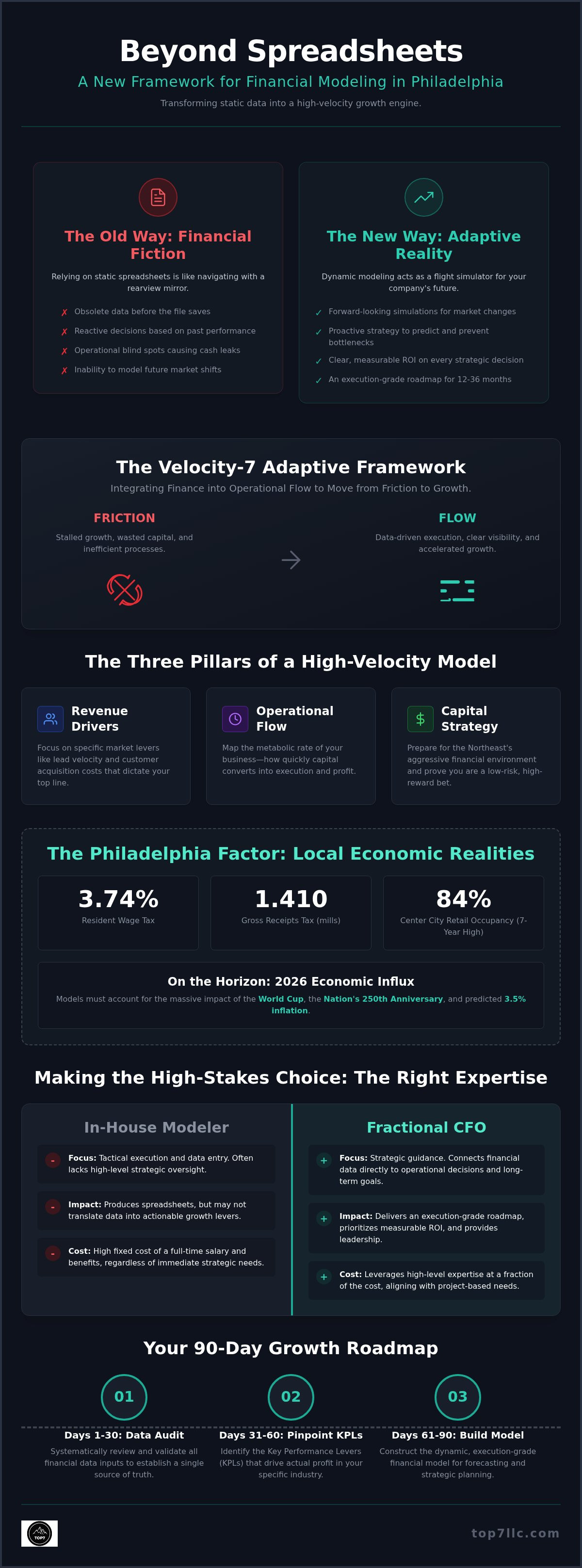
Accounting is a post-mortem. It tells you how you died or why you barely survived the last fiscal year. High-impact business financial modeling philadelphia is a flight simulator for your company's future. It is the difference between guessing your cash position in Q4 and knowing exactly which lever to pull when the Philadelphia Net Income Tax rate drops to 5.71% in 2026. If you are still looking at your P&L to decide your next move, you are already behind. You aren't leading; you are just reading history.
Most owners are trapped in "Financial Fiction." They build budgets based on "last year plus 5%" without accounting for the 3.5% inflation predicted for 2026. A real model isn't a static document buried in a folder; it is a living algorithm. To understand the core mechanics of these systems, you should explore What is Financial Modeling? as a foundational discipline. It’s a dynamic tool that must evolve as fast as the Center City retail market, which recently reached a seven-year occupancy high of 84%.
To better understand the technical skills required to build these growth engines, watch this helpful video:
The Three Pillars of a High-Velocity Model
A model that actually drives growth rests on three non-negotiable pillars. First, Revenue Drivers move beyond surface-level sales goals. They focus on the specific market levers, such as lead velocity or customer acquisition costs, that dictate your top line. Second, Operational Flow maps the metabolic rate of your business. It tracks how quickly capital converts into execution and profit. Finally, Capital Strategy prepares you for the aggressive financial environment of the Northeast corridor. Whether you are seeking debt, equity, or an exit, your business financial modeling philadelphia must prove you are a low-risk, high-reward bet for investors.
Why Philadelphia Businesses Stall Without It
Mid-market firms in Philly often hit a "Growth Ceiling" because their systems cannot handle increased complexity. Operational friction builds up, and without a model, you cannot see where the heat is coming from. Local economic factors add another layer of risk. With the Wage Tax for residents at 3.74% and the Gross Receipts Tax at 1.410 mills, your margins are constantly under pressure. Businesses that fail to model these specific local overheads find themselves leaking cash while their competitors capitalize on the massive economic influx expected from the 2026 World Cup and the nation's 250th-anniversary celebrations.
The Velocity-7 Framework: Integrating Finance into Operational Flow
A financial model is just a spreadsheet until it is plugged into a system that actually moves the needle. Most business financial modeling philadelphia firms produce static reports that sit in an inbox. They don't drive action. They don't solve problems. The Velocity-7 Adaptive Framework is the antidote to this operational friction. It transforms your finance function from a passive scorekeeper into an active navigator. Without an adaptive framework, your model is just a fancy calculator that tells you how much money you are losing without explaining why.
Think of your business as a high-performance engine. If the gears aren't aligned, adding more fuel just creates more heat. Modeling acts as the dashboard for the seven dimensions of growth, allowing you to see exactly where the friction is occurring. Are you hiring too fast for your cash conversion cycle? Is your tech stack outgrowing your revenue? Transitioning from "Friction" to "Flow" means moving from guessing to data-driven execution. You stop wondering if you can afford a move and start seeing the mathematical path to making it happen.
Moving from Friction to Flow
Friction is the silent killer of mid-market growth. We use the Velocity-7 framework to identify "leaks" in your current financial structure where capital is being wasted on inefficient processes or stagnant products. By applying agile-based transformation directly to your P&L, your financial model becomes a real-time feedback loop. It is not about waiting for month-end reports that are already ten days old. It is about having the visibility to make strategic adjustments today that protect your margins tomorrow. If you want to see how this system applies to your specific bottlenecks, you can explore the Velocity-7 Adaptive Framework in more detail.
Modeling for Strategic Execution
A model that only the CEO understands is a strategic failure. To be effective, your business financial modeling philadelphia must speak the language of your entire leadership team. Your Fractional CTO needs to see how a new software deployment impacts the 18-month runway. Your Fractional COO needs to know if the current labor spend aligns with projected output. In a volatile 2026 economy where the Philadelphia Fed predicts a 2.2% GDP expansion and headline CPI remains at 3.5%, adaptive modeling is your only defense. It allows you to pivot your strategy based on hard data rather than gut feelings or outdated forecasts.
Fractional CFO vs. In-House Modeler: Making the High-Stakes Choice
Stop assuming that a six-figure salary is the only way to buy financial intelligence. Many Philadelphia owners believe they must shell out $150,000 or more, plus benefits, to get a dedicated professional in a full-time seat. This is a legacy mindset that drains your cash before you see a single result. In reality, the most aggressive and capable minds in the region are moving toward fractional roles. They don't want a 40-hour desk job; they want to solve complex problems and drive results across multiple high-growth companies. If you are hiring a junior analyst to handle your business financial modeling philadelphia, you aren't buying strategy. You are buying a person who knows how to use Excel but doesn't know how to win a market.
The difference between tactical output and strategic guidance is the difference between a report and a roadmap. A junior in-house modeler will give you a spreadsheet that balances. A Fractional CFO will give you a simulation that reveals why your customer acquisition cost is killing your 2026 growth targets. One looks at the cells; the other looks at the ceiling of your business. Fractional leaders embed with your team in days, not months. They bring an immediate "velocity" benefit because they have already seen your specific friction points in ten other companies this year. They don't need a 90-day onboarding period to understand the Philly tax landscape; they are already executing within it.
The ROI of Fractional Leadership in Philadelphia
The math is simple. A full-time executive payroll is a fixed, heavy cost that limits your agility. Retainer-based fractional leadership allows you to access tier-one expertise at a fraction of the overhead. Beyond the cost-benefit analysis, you gain the value of "cross-pollination." A Fractional CFO sees dozens of models and operational structures. They know which levers are working in the Northeast corridor right now. This external perspective prevents the "echo chamber" effect that often leads to stagnant growth in mid-market firms. You aren't just paying for hours; you are paying for the aggregated intelligence of an entire portfolio of successes.
When to Stop DIY-ing Your Spreadsheets
If you are the founder and you are still building your own formulas, you are trapped. This is the "Founder's Trap," where your time is spent on $50-an-hour technical tasks instead of $5,000-an-hour strategic moves. Your homegrown model is likely a liability. It probably lacks the sensitivity analysis needed to navigate the 2026 inflation forecast of 3.5%. When your spreadsheets start hindering your decision-making speed rather than accelerating it, you've hit the limit. Professional business financial modeling philadelphia requires a level of precision that "good enough" Excel skills cannot provide. It’s time to stop forecasting fiction and start paying for an execution-grade engine.
Building Your Growth Roadmap: A 90-Day Financial Modeling Plan
Academic institutions want you to spend months mastering formulas. You don't have months; you have a business to scale. High-impact business financial modeling philadelphia isn't about theoretical perfection. It’s about execution-grade visibility. We strip away the fluff and focus on a 90-day sprint that moves your company from financial fog to tactical clarity. If you aren't seeing a clear ROI on your modeling efforts within the first quarter, you aren't modeling; you are just playing with spreadsheets.
Execution starts with a brutal Organizational Audit. We find the friction points where your data is siloed or outright wrong. Garbage in leads to garbage out. Once the data is clean, we identify the Key Performance Levers (KPLs) specific to your industry. These aren't generic metrics. They are the high-leverage activities that actually dictate your cash flow. We then build a Base Case and Stress Test scenarios. What happens if the Philly market dips? What if your customer acquisition costs spike? We don't guess. We simulate. Finally, we integrate the model into your sales and tech stacks and establish a weekly feedback loop. This ensures the model matches reality every single Monday morning.
Scenario Planning for 2026
The Philadelphia Fed expects a 2.2% GDP expansion in 2026, but with headline CPI averaging 3.5%, your margins are under siege. Agile pivots are mandatory, not optional. Our scenario planning accounts for interest rate shifts and regional economic changes like the 5.71% Net Income Tax rate. We model for "what-if" moments so you can pivot your strategy overnight when market conditions shift. This level of precision allows you to stay aggressive while your competitors are paralyzed by uncertainty.
Visualizing Success: Beyond the Grid
Rows and columns don't inspire action; insights do. We use dynamic dashboards to make financial data provocative and actionable for your entire leadership team. Adaptive modeling is a 24/7 strategic radar that alerts you to opportunities and threats before they hit your P&L. When your data is visual, the path to growth becomes undeniable. If you are ready to stop guessing and start driving, it is time to implement the Velocity-7 Adaptive Framework in your organization.
Stop settling for static reports that are obsolete by the time they hit your desk. A professional business financial modeling philadelphia plan ensures your capital is always working as hard as you are. By connecting your financial engine to your operational reality, you eliminate the friction that keeps most mid-market firms stuck at the growth ceiling. You don't need a better budget; you need a better simulation of your future success.
Top7: Philadelphia’s Partner for Execution-Grade Financial Modeling
Top7 doesn't just deliver spreadsheets. We deliver velocity. Most firms offering business financial modeling philadelphia provide you with a static document that gathers digital dust. We provide a weapon. Our seasoned professionals don't sit in a remote office sending reports; they embed directly into your Philly team. We become the tactical edge you need to dominate the Northeast corridor. We focus on profit and flow, not vanity metrics or academic theories. If your current financial partner isn't obsessed with your cash conversion cycle, they are a liability, not an asset.
Our Velocity-7 Adaptive Framework is designed specifically for mid-market companies that are ready to scale but can't justify the crushing overhead of a full-time C-suite. You get the strategic superiority of a Fractional CFO or Fractional CTO without the six-figure salary commitments. We identify the leaks, optimize the capital, and ensure your business is ready for the economic surge of 2026. We don't just point out problems. We install the systems that solve them. It is time to stop playing defense with your data and start using it to capture market share.
Fractional Leadership That Actually Leads
Our approach to Fractional CFO and CTO roles in the Philadelphia metro area is built on raw data and measurable results. We don't offer "advisory" sessions that lead to more meetings. We offer execution. In one recent engagement, we moved a mid-market client from operational friction to high-velocity flow in just 90 days. We didn't just fix their formulas; we rebuilt their entire strategic roadmap. We connected their tech stack to their financial engine and turned a leaking bucket into a profit machine. This is what happens when business financial modeling philadelphia meets real-world leadership.
Ready to Plug the Leaks?
The 2026 Philadelphia economy won't wait for you to get your numbers straight. With the BIRT Net Income Tax rate set at 5.71% and a massive influx of visitors for the World Cup, the stakes have never been higher. You can continue flying blind, or you can install a precision-guided growth system. We invite you to a strategic audit using the Velocity-7 dimensions to find exactly where your business is losing momentum. Stop guessing and start scaling with a Top7 executive today. The market doesn't reward hesitation; it rewards those who move with data-driven confidence.
Own Your Financial Future
Your business cannot survive on static spreadsheets and historical reports. To win in the current economy, you need business financial modeling philadelphia that acts as a real-time command center. We’ve shown you how to move from operational friction to high-velocity flow by ditching the "founder's trap" and embracing adaptive simulations. Whether it is navigating the 2026 tax shifts or preparing for the massive economic influx of the World Cup, your roadmap must be as dynamic as the market itself.
Top7, founded by Michael J. DiPiano Jr., provides the proprietary Velocity-7 Adaptive Framework to ensure your growth is never a matter of luck. Our directly embedded fractional leadership doesn't just hand you a file; we become the engine that drives your strategic execution. You have the choice to keep forecasting fiction or to start building a measurable path to profit. It’s time to plug the leaks and accelerate your results.
Schedule your Velocity-7 Strategy Audit with Top7 and take control of your trajectory today. Your next level of growth is waiting for a leader who is ready to execute.
Frequently Asked Questions
What is the difference between a financial model and a budget?
A budget is a static ceiling; a model is a dynamic simulation. Your budget tells you what you can't spend, while business financial modeling philadelphia tells you what happens if you do. One is a restrictive plan for the year, and the other is a living engine that predicts how operational changes impact your bottom line in real time.
How much does business financial modeling cost in Philadelphia?
Costs are never standardized because the complexity of your operational friction dictates the scope. While some firms might charge hourly or project based fees, the real calculation is the ROI of the decisions the model enables. You aren't paying for a spreadsheet; you are paying for the strategic clarity to avoid expensive missteps in a volatile market.
Do I need a Fractional CFO if I already have a CPA?
Yes, because your CPA is a historian and your Fractional CFO is a navigator. CPAs focus on tax compliance and historical accuracy. They look at what happened. A Fractional CFO uses modeling to determine what will happen. If you want to scale, you need someone focused on the 36 month horizon, not just the last quarter's filings.
Can financial modeling help me secure a business loan in PA?
Absolutely. Lenders in the Philadelphia region don't just want to see your balance sheet; they want to see your repayment logic. A professional model proves you understand your unit economics and have stress tested your growth plan. It turns a risky ask into a data backed investment opportunity that banks can actually approve.
How long does it take to build a strategic financial model?
We don't believe in multi month academic exercises. A foundational, execution grade model should be operational within weeks. Our 90 day sprint ensures your data is audited, your levers are identified, and your leadership team is using the model to make decisions. Speed is a competitive advantage; don't let a slow build kill your momentum.
What software do you use for financial modeling?
Excel remains the gold standard for flexibility, but the tool matters less than the logic behind the formulas. We integrate your model with your existing sales and tech stacks to ensure data flows automatically. The goal is a seamless dashboard that provides a 24/7 strategic radar, not a siloed file that requires manual updates every Friday.
Is financial modeling only for tech startups?
No. While startups use it for fundraising, mid market companies in Philadelphia use it for survival and dominance. Whether you are in manufacturing, professional services, or retail, you face the same friction points. Any business with complex labor costs, inventory, or high overhead needs a model to protect its margins from 2026 inflation and tax shifts.
How does the Velocity-7 framework improve my bottom line?
The Velocity-7 framework turns business financial modeling philadelphia into an operational command center. It identifies the leaks where you are wasting capital and points exactly to the levers that drive profit. By aligning your finance, technology, and operations, it eliminates the friction that stalls growth and converts your strategy into measurable cash flow.


Comments