
B2B Tech Marketing Strategy: A Practical 2026 Guide

What if your B2B tech marketing isn’t underperforming because you need more channels, but because your positioning, pipeline goals, and execution aren’t connected? A marketing strategy for B2B tech companies should do more than fill a calendar with campaigns. It should give buyers a clear reason to choose you and give sales opportunities marketing can help create and advance.
If your product story sounds technical but not distinctive, or your team can’t explain which channels deserve investment, the problem may not be a lack of activity. It may be a lack of focus. More content and more spend won’t fix that on their own.
This practical 2026 guide shows you how to define your ideal customer, sharpen your positioning, prioritize channels around the buying journey, and build a measurable plan marketing and sales can own together. You’ll also see when senior leadership support, including fractional CMO guidance, may help turn strategy into accountable execution. Start with alignment, then scale what supports qualified pipeline.
Table of Contents
Why B2B Tech Companies Need a Marketing Strategy Before Scaling Activity
How to Build a B2B Tech Marketing Strategy in Five Decisions
How to Compare B2B Tech Marketing Channels and Strategy Trade-Offs
How to Turn the Strategy into an Actionable B2B Tech Marketing Plan
When B2B Tech Companies Need Fractional Marketing Leadership
Why B2B Tech Companies Need a Marketing Strategy Before Scaling Activity
More campaigns won’t fix unclear positioning. If your product story is a list of features and every team is chasing a different channel, marketing can stay busy without helping buyers understand why your solution fits. A marketing strategy for B2B tech companies connects four choices: which market to serve, what value to promise, how to reach buyers, and which business outcomes to track. That’s the foundation of business-to-business (B2B) marketing.
A channel calendar is not a strategy. Strategy sets priorities and trade-offs; tactics are the campaigns and activities used to carry those choices out. A press release may earn attention, for example, but attention alone doesn’t show whether the right buyers understand the offer or take a next step. Before scaling activity, connect each marketing effort to a clear path from buyer need to sales conversation.
For a practical perspective on B2B marketing, watch this video:
What a B2B tech marketing strategy must decide
Start by choosing a market segment and a buyer problem worth prioritizing. “Companies that need better data” is too broad to guide a campaign. A more useful choice identifies a specific type of organization and a problem its buyers recognize. Then explain how your offer differs from alternatives in language buyers can understand, not just in technical specifications.
Connect marketing goals to sales outcomes the business can track, such as qualified opportunities or movement from an initial conversation to a sales-accepted opportunity. The right measures depend on your sales process. Agree on what counts, who records it, and how marketing and sales will review it so marketing’s contribution is visible.
Why technical buyers need a clear path to value
Technical evaluators and business decision-makers may assess different risks. An engineer might focus on integration, security, or reliability; a business leader might ask whether the solution addresses a costly problem and fits the organization’s priorities. These are useful distinctions, not assumptions that every purchase involves the same roles or concerns. Confirm them with customer and sales insight.
Translate capabilities into outcomes each audience can evaluate. Instead of leading with an API feature, explain what it lets the customer connect or do. Instead of listing automation functions, clarify which workflow they support. Keep the technical proof, but make the value clear. That’s how positioning gives campaigns a shared direction.
How to Build a B2B Tech Marketing Strategy in Five Decisions
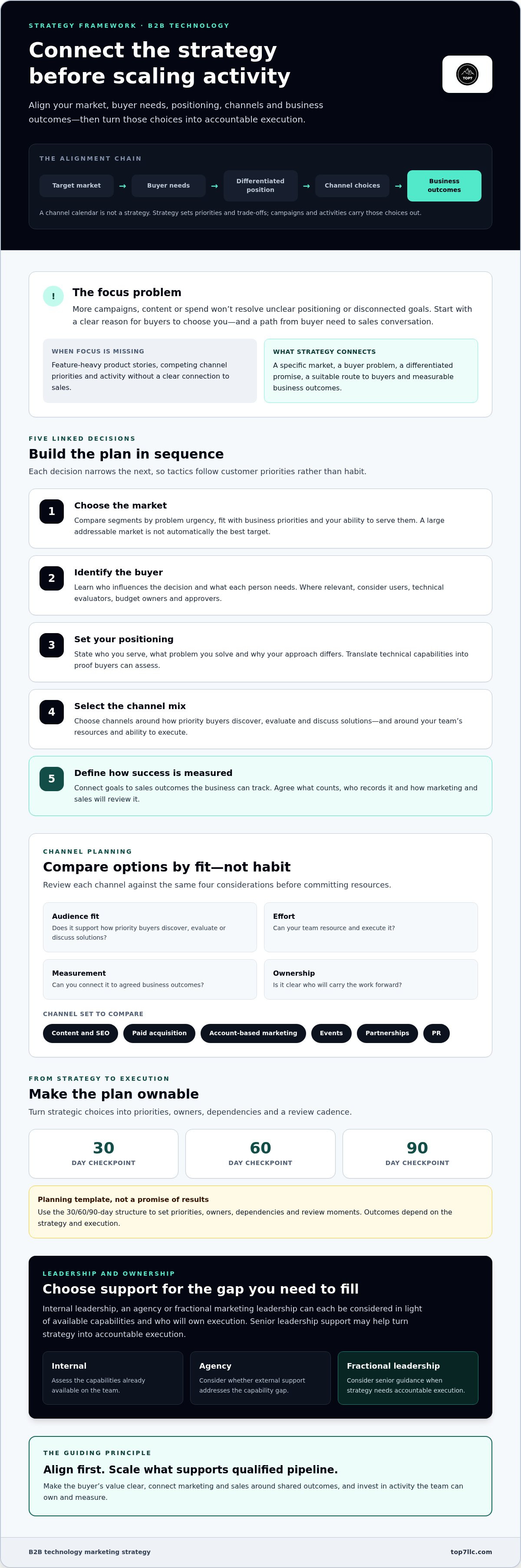
Build the plan in sequence. Each decision narrows the next, so your channel choices and measures follow from customer priorities rather than habit. This is the working logic behind a marketing strategy for B2B tech companies: evidence shapes focus, and focus shapes execution. For additional grounding, review these B2B marketing principles.
Choose the market. Compare segments by the urgency of the problem, fit with your business priorities, and your ability to serve that market well. A large addressable market isn’t automatically the best target if your offer or capabilities don’t match its needs.
Identify the buyer. Map the people involved where relevant: users, technical evaluators, budget owners, and approvers. Their concerns may differ, so learn who influences the decision and what each person needs to move forward.
Set your positioning. State who you serve, what problem you solve, and why your approach differs from alternatives. Translate technical capabilities into proof buyers can assess, such as product evidence or a clear explanation of how a capability addresses their problem.
Select the channel mix. Choose channels based on how your priority buyers discover, evaluate, and discuss solutions, as well as your team’s resources and ability to execute. A channel earns a place because it supports the strategy, not because it’s popular.
Define measurement. Connect marketing indicators to sales outcomes your teams can track. Agree on what makes an opportunity qualified and how marketing and sales will review progress. Use the findings to adjust priorities, not just report activity.
Ground the decisions in customer evidence
Use buyer interviews, sales conversations, and existing customer evidence to test your choices. Look for recurring problems, objections, alternatives considered, and the words customers use to describe value. Support interactions can also reveal where expectations and experience diverge.
Separate what you’ve heard or observed from what the team believes. “Technical buyers care most about feature X” is an assumption until customer conversations or sales evidence support it. Record the evidence, note gaps, and identify what still needs validation. That discipline keeps positioning from becoming internal opinion dressed up as market insight.
Turn positioning into direction
Write a concise statement that links your audience, their problem, your solution, and your difference. Then check whether the channel mix and measures reinforce that same direction. If they don’t, revisit the choices before adding campaigns.
If these decisions need an accountable senior owner, learn about Top7’s strategic guidance as one option for shaping the plan and aligning its execution.
How to Compare B2B Tech Marketing Channels and Strategy Trade-Offs
There’s no universal best channel. Content and SEO, paid acquisition, account-based marketing, events, partnerships, and PR play different roles, and each demands different resources. For a marketing strategy for B2B tech companies, compare each option against the same criteria: audience fit, place in the buying journey, effort, measurement, and who will own the work.
A channel becomes a strategic choice only when it serves a defined audience and a measurable purpose. If you can’t explain who it should reach, what buyer action it supports, and how you’ll assess its contribution, it’s a guess, not a plan.
Match channel roles to the B2B buying journey
Different channels can support different buyer needs. Educational content and SEO can help prospective customers understand a problem or explore a category. Sales enablement materials, product evidence, and technical explainers can help evaluators compare options. Events may create opportunities for direct conversation, while PR can build awareness or reinforce credibility. Neither visibility nor attendance guarantees qualified pipeline.
Content and SEO: Consider these when buyers search for answers or need useful information before a sales conversation. Account for research, subject-matter input, production, and ongoing updates.
Paid acquisition: Assess whether the audience can be reached through the chosen placements and whether you can track meaningful actions beyond clicks.
Account-based marketing: Consider it when sales and marketing can coordinate around selected accounts, with clear criteria and tailored follow-through.
Events and partnerships: Look for a credible audience match and a defined plan for follow-up. Factor in coordination and the time required to turn conversations into next steps.
PR: Assess whether the story matters to the audience you need to reach, and define how earned attention supports broader positioning or demand efforts.
These are roles to evaluate, not a ranking. A channel’s value depends on your offer, audience, sales cycle, and execution.
Choose a channel mix your team can actually execute
A channel that fits buyers on paper can still fail if nobody has the capacity or expertise to run it. Check who will create and review content, coordinate with sales, manage campaigns, and report results. Identify dependencies before launch: paid campaigns need reliable conversion tracking; account-based efforts need usable account data and sales coordination; technical content may require review from subject-matter experts.
Start with a small number of priority channels. For each, define the audience, role in the buying journey, owner, effort, and review measure. Test the mix, learn where execution gets stuck, and expand only when the team can support the added work. Focus beats a scattered presence everywhere.
How to Turn the Strategy into an Actionable B2B Tech Marketing Plan
A strategy becomes useful when people know what to do, who owns it, and how the team will decide whether to continue. Turn your marketing strategy for B2B tech companies into a working plan with a limited set of priorities, named owners, clear dependencies, and a regular review cadence. Otherwise, even sound positioning can dissolve into disconnected tasks.
Set priorities, owners, and a useful operating rhythm
Choose initiatives that directly support your positioning and the buyer journey. For each one, document its purpose, accountable owner, supporting teams, dependencies, and next decision point. Marketing may lead campaign execution, while sales, product, or technology teams contribute customer insight, product evidence, or technical review. Shared input doesn’t mean shared accountability: make one person responsible for moving each initiative forward.
A 30/60/90-day plan can help structure the work. Treat it as a planning template, not a guaranteed results timeline:
First 30 days: Confirm priorities, owners, baseline measures, and dependencies. Resolve gaps in customer evidence, tracking, or sales coordination.
By 60 days: Put priority initiatives into motion and review early indicators, execution barriers, and buyer or sales feedback.
By 90 days: Assess what to continue, adjust, or stop. Use the findings to set the next priorities, not to assume every initiative should scale.
Set review meetings at a cadence the team can sustain. Use them to make decisions: continue the work, change the approach, or stop investing effort. A meeting that only reports activity is not an operating rhythm.
Measure progress without confusing activity with impact
Separate leading indicators, which show whether planned work is reaching and engaging the intended audience, from lagging outcomes, such as qualified opportunities or opportunity contribution where your data allows. Possible indicators include engagement from target accounts, conversion between funnel stages, and sales acceptance. Choose measures that fit the initiative and agree on definitions with sales before launch.
Review leading indicators often enough to spot execution issues. Assess lagging outcomes over a timeframe appropriate to your sales cycle. Document attribution limits: several interactions may influence an opportunity, and a recorded touchpoint alone doesn’t prove that marketing caused the result. Be clear about what the data shows, what it suggests, and what remains uncertain.
If unclear ownership or cross-functional coordination is slowing the plan, learn about Top7’s strategic and execution support.
When B2B Tech Companies Need Fractional Marketing Leadership
A sound marketing strategy for B2B tech companies still needs someone with the authority to make it real. But a leadership gap, a lack of campaign capacity, and weak coordination are different problems. Choose the support model that addresses the actual bottleneck, not the one that sounds most impressive.
Decide whether the gap is strategy, capacity, or accountability
Start with the symptoms. Are priorities unclear? Are campaigns fragmented across teams? Does nobody have the authority to align marketing with sales, product, and technology? These are prompts to investigate a possible leadership or accountability gap. If the direction is clear but a particular campaign needs specialist execution, the need may instead be delivery capacity.
Technical alignment matters, too. If marketing commitments depend on product capabilities, integrations, or technical proof, ask whether marketing leadership alone can resolve the gap. A fractional CTO may be relevant where senior technology leadership is also needed to connect technical direction with market commitments. Don’t confuse a need for coordination with a need to promise capabilities the product can’t support.
Evaluate embedded leadership against other support models
Compare the options by decision authority, continuity, internal collaboration, capability, and delivery ownership. An internal marketing leader can build ongoing context and relationships, but may not cover every specialist skill the team needs. An agency can provide campaign execution, but clarify who sets priorities, approves decisions, coordinates sales input, and owns follow-through. An external team shouldn’t be expected to supply internal authority by default.
Fractional leadership may fit when the company needs senior direction and an accountable owner but isn’t choosing a full-time leadership role. It isn’t automatically the right answer. Confirm the scope of authority, expected involvement, internal support, and how decisions will be made. If the main constraint is campaign production, specialist execution may be more appropriate than adding a strategic leader.
Top7 offers fractional CMO leadership alongside strategic planning and advanced project management. Where marketing plans depend on technical alignment, its fractional CTO offering may also be relevant. Top7 describes its Velocity-7 Adaptive Framework as an agile-based approach to moving organizations from operational friction toward efficient flow.
Make the choice against the work in front of you: who will set direction, coordinate teams, and keep execution accountable? If you’re assessing a leadership or coordination gap, learn how Top7 approaches growth and leadership needs.
Put Your B2B Tech Marketing Strategy into Motion
A focused marketing strategy for B2B tech companies connects a defined market and buyer problem to clear positioning, intentional channel choices, and outcomes sales can track. The strongest plan doesn’t try to do everything. It assigns owners, accounts for dependencies, and gives the team a regular way to decide what to continue, adjust, or stop.
Leadership support should match the gap. You may need specialist execution, an accountable senior marketing owner, or better coordination across marketing, sales, product, and technology. Top7 offers fractional CMO and fractional CTO leadership, strategic planning, advisory services, and advanced project management. Its Velocity-7 Adaptive Framework is described as an agile-based approach to moving organizations from operational friction toward efficient flow.
If you’re weighing how to turn strategy into coordinated execution, discuss your strategy and leadership needs with Top7. Make the next move deliberately, then build a plan your team can own and improve.
Frequently Asked Questions
What is a marketing strategy for a B2B tech company?
It’s a set of connected choices about which market to serve, which buyer problem to solve, how to position the offer, which channels to prioritize, and how to measure progress. It guides campaigns and sales support rather than replacing them. A useful strategy links customer evidence and business priorities to accountable execution, so teams can explain why each activity matters and what outcome it is meant to support.
How do you create a B2B tech marketing strategy?
Start by selecting a target segment and validating its needs with customer and sales evidence. Define the relevant buying committee, clarify your positioning, and choose channels that fit how buyers research and evaluate solutions. Then assign owners and measures. Review the plan regularly and adjust when evidence changes. Don’t scale activity until the team can explain why each priority matters and how it connects to business goals.
Which marketing channels work best for B2B tech companies?
There’s no universally best channel for every B2B tech company. Content and SEO, paid acquisition, account-based marketing, events, partnerships, and PR can support different audiences and buying stages. Compare each option by buyer fit, effort, measurement, and your team’s ability to execute. Choose based on your strategy and available evidence, then test and review the mix. Don’t copy another company’s channels without checking whether they fit your buyers.
How should B2B tech companies measure marketing strategy performance?
Measure progress against the strategy, using indicators such as qualified engagement, movement between funnel stages, and contribution to sales opportunities when reliable data is available. Pair these lagging outcomes with leading indicators that help the team learn sooner. Define measure ownership and review cadence before launching work. Document attribution limitations, too. Activity volume can show what the team did, but it doesn’t prove marketing caused a sales result.
Can a B2B tech company build a marketing strategy without a CMO?
Yes, but someone must own strategic choices, cross-functional alignment, and performance reviews. Depending on the company’s needs and capabilities, that owner might be a founder, an internal marketing lead, or a fractional executive. First identify the gap. If the strategy is clear but campaigns lack specialist capacity, execution support may be a better fit than senior leadership. The key is accountability, not a particular job title.
When should a B2B tech company use fractional marketing leadership?
Consider fractional marketing leadership when the company needs senior direction but isn’t ready to fill that need with a full-time executive, or when priorities and execution lack clear ownership. Identify whether the real gap is strategy, capacity, or accountability first. Then compare fractional support with internal leadership and agency execution based on decision authority, scope, collaboration, and who owns follow-through. Fractional support isn’t automatically the right fit.
How often should a B2B tech marketing strategy be reviewed?
Review execution regularly enough to identify blocked work, new buyer evidence, or emerging dependencies, then revisit strategic assumptions at a deliberate planning interval. The right cadence depends on your market and sales cycle. Keep the strategy stable enough for teams to execute, but change it when evidence shifts. Don’t change direction simply because a new channel or trend becomes popular; assess whether it supports your target buyers and business priorities.



Comments