

21 Crucial Questions to Ask a Potential Fractional CFO Before You Hire an Expensive Historian
- Robert Fitzgerald
- May 17
- 13 min read

Updated: May 20
Most business owners think they're hiring a financial strategist when they're actually just paying a premium for a glorified historian to document their decline. You've likely felt the frustration of looking at accurate balance sheets that offer zero guidance on how to actually scale your revenue or fix your hemorrhaging cash flow. It's a common trap where the data is correct but the strategy is non-existent. Knowing the right questions to ask a potential fractional cfo is the only thing standing between you and a partner who drives velocity rather than just recording it.
You deserve predictable cash flow and a partner who isn't afraid to challenge your assumptions to find operational efficiency. In industries like construction, the right leadership often drives a 10% to 15% improvement in profit margins within the first year by focusing on strategic capital allocation. This article promises to give you the exact filter you need to weed out the "accountants with better titles" and secure a high-level navigator. We'll break down 21 high-stakes questions designed to expose the bookkeepers in disguise and find the strategic partner who will actually help you win the market.
Key Takeaways
Identify the "Historian Trap" and learn why hiring for accuracy alone is a recipe for stagnant growth and wasted capital.
Master the specific questions to ask a potential fractional cfo to ensure they drive offensive maneuvers rather than just reporting on the past.
Distinguish between passive consultants and fractional executives who take full ownership of your financial outcomes and board-level representation.
Filter for candidates with the backbone to challenge your assumptions and kill unprofitable projects before they drain your resources.
Discover how the Velocity-7 Adaptive Framework transforms traditional accounting into an agile system for rapid operational efficiency.
Table of Contents
Beyond the Balance Sheet: Why Most CFO Interviews Hire Historians, Not Strategists
The "Velocity" Test: Questions to Gauge Strategic and Operational Impact
Fractional Executive vs. Part-Time Consultant: Interviewing for Ownership
The Hard Truth Filter: Questions that Reveal if They’ll Challenge Your Dogma
The Velocity-7 Approach: How Top7 CFOs Execute Where Others Only Report
Beyond the Balance Sheet: Why Most CFO Interviews Hire Historians, Not Strategists
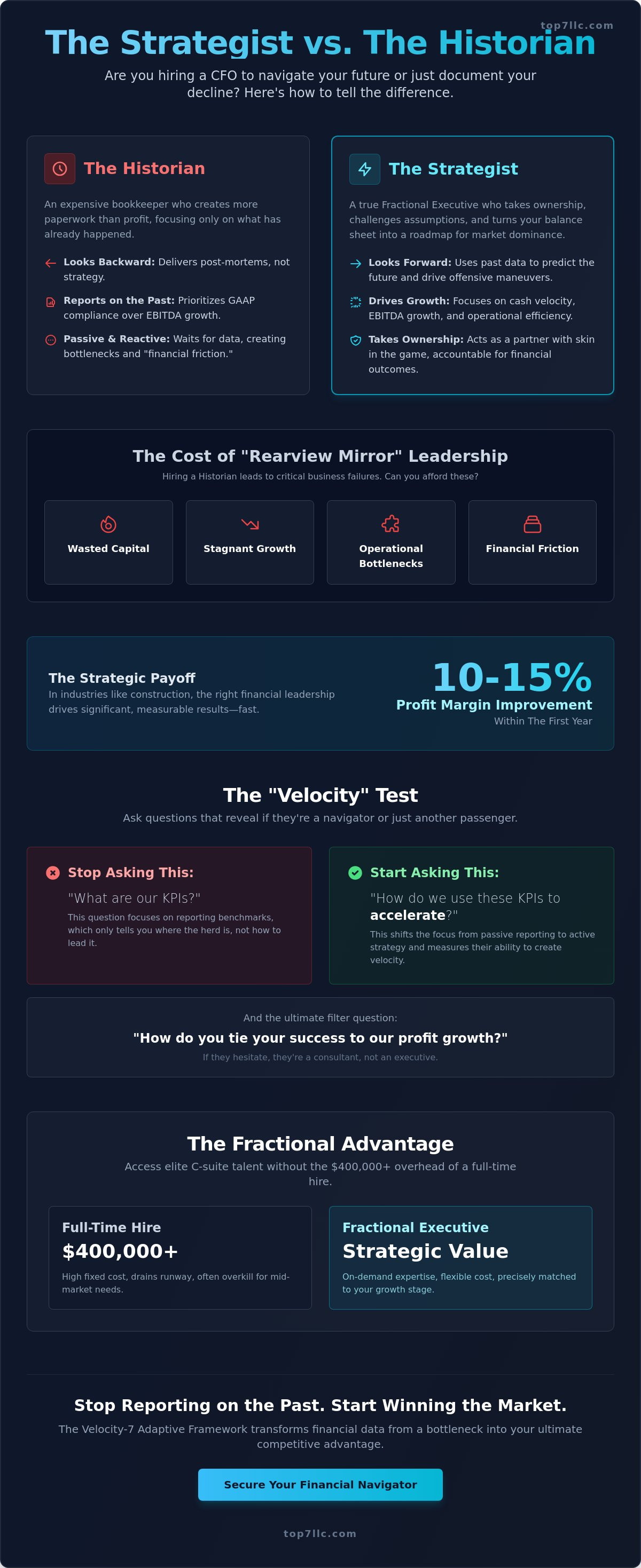
Stop hiring people to tell you what happened last month. That's a post-mortem, not a strategy. Most CEOs walk into interviews looking for accuracy, but they leave with a "Historian" who can't see past the previous quarter's losses. A Historian CFO is an executive who prioritizes GAAP compliance over EBITDA growth. While accuracy is a prerequisite, it isn't the goal. You need someone who can turn a balance sheet into a roadmap for market dominance. The specific questions to ask a potential fractional cfo determine if you're hiring a navigator or just another expensive bookkeeper who creates more paperwork than profit.
Mid-market companies across the US don't usually fail because they lack capital. They fail because of financial friction. This friction occurs when your data is a bottleneck rather than a fuel source. If it takes your team three weeks to close the books, you can't pivot. You can't make a strategic purchase. You're effectively flying blind. The "Velocity" mindset changes this by asking one critical question: how fast can your financial data turn into a pivot or a purchase? If the answer isn't "instantly," your CFO is failing you.
To better understand this concept, watch this helpful video:
Real leadership requires a partner who treats your capital like a weapon. When a CEO lacks a financial navigator they can trust, the psychological toll is immense. You're the one staying up at 2 AM wondering if your payroll account is actually as healthy as the spreadsheet says. You need a Fractional Executive who provides the tactical foresight to keep you ahead of the competition.
The Cost of "Rearview Mirror" Leadership
Stagnant financial reporting creates operational bottlenecks that kill growth-stage companies. If your CFO only looks at the rearview mirror, you'll hit every wall in front of you. Accuracy is the baseline, not the final deliverable. If they aren't talking about EBITDA growth and cash velocity, they're just an expensive bookkeeper. A true strategist uses the past to predict the future, ensuring your cash flow remains predictable even during market volatility.
The Fractional Advantage in 2026
By 2026, the fractional model has become the standard for lean, high-growth firms in hubs like Boston, Chicago, and Austin. You get access to elite C-suite talent without the $400,000 plus full-time overhead that drains your runway. The Top7 approach moves your business from friction to flow by providing absolute financial clarity. We don't just report on the score; we help you win the game. When considering the questions to ask a potential fractional cfo, look for someone who understands that financial clarity is the ultimate competitive advantage.
The "Velocity" Test: Questions to Gauge Strategic and Operational Impact
Stop asking about industry benchmarks. Benchmarks tell you where the herd is, not how to lead it. Shift the conversation from "What are my KPIs?" to "How do we use these to accelerate?" This is the core of the Velocity Test. When hiring a fractional CFO, you need to know if they can handle a market that shifts 20% in a single quarter. Do they have an adaptive framework, or will they just ask for more time to analyze the data? You need a navigator who sees the storm before it hits your P&L.
You need someone with skin in the game. Ask them directly: "How do you tie your success to our profit growth?" If they hesitate, they're a consultant, not an executive. A true partner understands that their value is measured in the velocity of your growth. They should be dissecting your supply chain, sales cycles, and tech-stack efficiency to find hidden margins. If you want to stop guessing and start executing, you need a Fractional CFO who operates at the speed of your ambition.
Questions for Strategic Execution
Execution is where most financial plans go to die. Use these specific questions to ask a potential fractional cfo to see if they can actually lead a team:
"Can you walk me through a time you identified a growth bottleneck that wasn’t visible on the P&L?"
"What is your 90-day roadmap for moving us from operational friction to efficient flow?"
"How do you integrate with our CTO or COO to ensure technology spend drives revenue?"
If they can't explain how they collaborate with other departments to drive the bottom line, they will become a silo that slows you down. You aren't looking for a "Yes-Man." You're looking for a strategist who ensures every dollar spent is a tactical maneuver toward market dominance.
Questions for Capital Strategy
The current US economy demands a sophisticated approach to the capital stack. You need to know if they can handle more than just simple bank reconciliations. Ask about their experience with debt restructuring versus equity raises in high-interest environments. How would they prepare your firm for a liquidity event or a major acquisition in the next 24 months? Their answer should involve more than just "cleaning up the books." It should involve a proactive plan to maximize valuation and minimize dilution. They must prove they can manage complex capital structures without blinking.
A savvy CFO will also identify opportunities to build business credit through strategic vendor selection. You might discover The CEO Creative as an example of how to align branding needs with net-30 credit terms to improve your firm's financial profile.
Fractional Executive vs. Part-Time Consultant: Interviewing for Ownership
Stop hiring spectators. A consultant tells you your house is on fire; a fractional CFO grabs the hose and leads the team to safety. Most business owners fail to recognize the "Ownership Gap" until a crisis hits and their advisor is nowhere to be found. You aren't looking for a weekly report. You're looking for an executive who owns the outcome of your financial strategy. When refining your questions to ask a potential fractional cfo, you must filter for leadership, not just technical expertise.
Ask them directly: "Will you represent us in board meetings or just provide the slides?" If they won't stand in front of your investors, they aren't an executive. You also need to uncover their true capacity. Ask how many other clients they have and how they ensure they are "embedded" in your culture. You don't want a side-hustler who is just "between jobs." Career fractional leaders treat your business as a priority, not a temporary stopgap. If they're just looking for a paycheck while they hunt for a full-time role, they'll abandon you the moment a better offer appears.
Embedded Leadership vs. External Advice
Top7 emphasizes the "embedded" nature of our leaders because external advice is often useless without execution. You need to know their process for managing your existing internal finance team. A real leader doesn't just bypass your staff; they elevate them. Ask: "How do you handle conflict with other C-suite members when the data says they are wrong?" A true partner doesn't back down to protect a contract. They push for the truth because they are committed to your long-term profit growth, even if it makes the room uncomfortable.
The "Velocity-7" Perspective on Ownership
An embedded CFO uses the Velocity-7 Adaptive Framework to solve complex problems in real-time. They don't wait for the monthly close to tell you that you're over budget. They build systems that provide immediate feedback loops. This distinction is vital when choosing between a Fractional CFO vs. Accountant: What Founders Need. While an accountant looks at what happened, our fractional executives focus on what is happening right now and what will happen next. When finalizing your questions to ask a potential fractional cfo, focus on their ability to integrate into your operations and drive results from the inside out. Ownership isn't a buzzword; it's a tactical requirement for scaling a mid-market company.
The Hard Truth Filter: Questions that Reveal if They’ll Challenge Your Dogma
If your CFO agrees with everything you say, one of you is redundant. And it isn’t the guy signing the checks. A "Yes-Man" CFO is a strategic liability who will watch you drive your company off a cliff as long as the reports are formatted correctly. You need a partner who has the professional courage to tell you that your "innovation project" is actually a cash-shredder. When preparing your questions to ask a potential fractional cfo, you must include filters for backbone and intellectual honesty.
Start with this: "Tell me about a time you told a CEO their favorite project was a financial disaster." Listen for the specifics. Did they back down when the founder got defensive, or did they hold the line with data? Follow up with: "What is the most uncomfortable financial truth you think most companies in our industry are ignoring?" If they give you a generic answer about inflation or labor costs, they aren't thinking deeply enough. You want the person who points out the systemic inefficiencies that everyone else is too polite to mention. This is how you find a mentor, not just a technician.
Testing for "Provocative Mentorship" is about finding someone who values your bottom line more than your ego. Ask them: "If I want to grow 30% this year, what is the first thing you would tell me to stop doing?" A true strategist knows that growth is often about subtraction, not just addition. They should be looking for the 20% of activities that drive 80% of the results and suggesting you kill the rest. If they only talk about what to add, they don't understand operational velocity.
Testing Emotional Intelligence and Spine
The best CFOs for Top7 clients are those who aren’t afraid to be the "bad guy" for the sake of the bottom line. Delivering bad financial news to a founder who is emotionally attached to the business requires a unique blend of empathy and clinical detachment. Ask them: "How do you deliver bad financial news to a founder who is emotionally attached to the business?" If they don’t ask you hard questions in the interview, they won’t do it on the job. A lack of pushback during the hiring process is a massive red flag that they will be a passive observer in your C-suite.
Identifying Growth Dogmas
Revenue is vanity, profit is sanity, and cash is king. You need to spot a CFO who lives by this mantra. Ask about their philosophy on aggressive growth versus sustainable EBITDA. Chasing the wrong metrics doesn't just hurt the bank account; it leads to the hidden costs of executive burnout. When you're constantly fighting fires caused by poor capital allocation, your health and your business suffer. You need a partner who protects your time as much as your treasury. If you're ready for a partner who tells the truth, hire a Fractional CFO who values results over consensus.
The Velocity-7 Approach: How Top7 CFOs Execute Where Others Only Report
Reporting is a commodity. Execution is a weapon. Most firms will give you a list of questions to ask a potential fractional cfo that focus on technical skills, but they miss the most critical factor: the system of execution. At Top7, we don't just provide advice from the sidelines. We embed directly into your operations to solve complex financial strategy problems in real-time. We aren't here to be your "accountant plus"; we're here to be the strategic engine that drives your growth and velocity.
Our secret weapon is the Velocity-7 Adaptive Framework. This isn't a static set of rules but an agile-based transformation system designed for the modern business environment. While other CFOs are still trying to reconcile last month's data, a Top7 executive is using our framework to identify offensive strategic maneuvers for the next quarter. We move beyond basic accounting to create a system where financial data dictates tactical pivots. If your current financial lead can't explain their proprietary system for transformation, they don't have one. They're just winging it with your capital.
You need a battle-tested leader who has already navigated the growth obstacles unique to the US market. Our executives have seen it all, from high-interest debt restructuring to aggressive M&A cycles. When you're finalizing your questions to ask a potential fractional cfo, the ultimate litmus test is whether they have a proven methodology or just a resume. Top7 leaders bring a level of professional dominance that turns financial clarity into a sustained competitive advantage.
Why Top7 is Different
We focus exclusively on mid-market companies in major hubs like Boston, Chicago, and Dallas. These markets demand a "No-Fluff" commitment that most consulting firms can't handle. We don't sell hours; we sell results and velocity. Our approach bridges the gap between interim crisis management and long-term strategic growth. Whether you're fixing a hemorrhaging cash flow or preparing for a massive exit, we provide the steady hand and the sharp mind required to win. We aren't interested in being a line item on your P&L; we're interested in being the reason your P&L looks better every single month.
Start Your Transformation
If you're tired of "rearview mirror" leadership and data that arrives too late to matter, it's time to change the game. In your first 30 days with a Top7 executive, expect the friction to disappear. We'll audit your capital stack, clear the operational bottlenecks, and set a roadmap that prioritizes EBITDA growth over vanity metrics. Stop settling for historians who document your decline. It's time to hire a navigator who owns the outcome. Schedule a Strategy Audit with a Top7 CFO today and see what real financial velocity looks like.
Command Your Financial Future with Velocity
Hiring a financial leader who only reports on the past is a luxury your growth strategy cannot afford. You've now seen the clear distinction between a passive historian and an embedded executive who owns your profit growth. By utilizing these specific questions to ask a potential fractional cfo, you've gained the filter necessary to protect your capital and your sanity. True leadership isn't about GAAP compliance alone; it's about the tactical maneuvers that drive market dominance.
Top7 specializes in the US mid-market, specifically for companies generating between $10 million and $100 million in revenue. Our battle-tested executives don't just give advice. We implement the proprietary Velocity-7 Adaptive Framework to turn your financial data into a high-speed engine for growth. Don't let another quarter slip away with stagnant margins and "rearview mirror" reporting. You need a partner who values results over consensus.
Stop leaking profit. Get a CFO who drives velocity.
Your business has the potential for explosive growth. It's time you had the financial navigator required to reach it.
Frequently Asked Questions
What is the main difference between a Fractional CFO and a Controller?
A Controller manages the score while a Fractional CFO wins the game. Controllers focus on historical accuracy, GAAP compliance, and closing the books. A CFO uses that data to drive future strategy, maximize EBITDA, and accelerate cash velocity. If you only have a Controller, you're looking at the rearview mirror. You need a CFO to navigate the road ahead and identify offensive strategic maneuvers.
How many hours a week does a Fractional CFO typically work?
You aren't buying hours; you're buying strategic results. Most engagements range from 5 to 20 hours per week depending on your company's complexity and growth stage. Top7 executives focus on high-impact outcomes rather than clock-punching. We embed into your C-suite to solve specific bottlenecks, ensuring your team moves from operational friction to efficient flow without the overhead of a full-time executive.
Can a Fractional CFO help with raising capital or selling my business?
Strategic capital strategy is a core deliverable of a high-level partner. Whether you're navigating debt restructuring or preparing for a major acquisition, a CFO manages your capital stack to minimize dilution and maximize valuation. They represent your firm in board meetings and lead the due diligence process. This ensures your business is "exit-ready" at all times, even if you aren't planning to sell this year.
What are the red flags to watch for when interviewing a Fractional CFO?
The biggest red flag is a candidate who doesn't ask you uncomfortable questions. If they focus only on compliance and reporting, they're a glorified accountant. When considering questions to ask a potential fractional cfo, watch for those who avoid discussing profit growth or operational efficiency. A "Yes-Man" who agrees with your every assumption will eventually become a liability that ignores systemic financial risks.
How long does a typical Fractional CFO engagement last?
Transformation takes time, but results should be immediate. Most mid-market engagements last between 6 and 24 months. The first 90 days focus on stabilizing cash flow and implementing an adaptive framework. Once the foundation is solid, the relationship often shifts into a long-term advisory role. We stay as long as we are driving measurable velocity and profit growth for your organization.
How does a Fractional CFO integrate with my existing accounting team?
An effective executive doesn't replace your internal staff; they elevate them. They provide the leadership your bookkeepers and controllers lack, turning a reactive department into a proactive strategic unit. By managing the internal finance team, the CFO removes the burden of financial oversight from the CEO. This allows you to focus on high-level vision while they ensure the operational machinery is running at peak efficiency.
What is the typical ROI of hiring a Fractional CFO for a $20M company?
For a $20 million company, the ROI is measured in margin expansion and capital efficiency. Industry data shows that construction firms often see a 10% to 15% improvement in profit margins within the first year of strategic financial support. By identifying hidden growth bottlenecks and optimizing your supply chain, a CFO pays for themselves many times over. They turn financial clarity into a kőkemény competitive advantage.
Do I need a Fractional CFO if I already have a great CPA?
Your CPA is a compliance expert; your Fractional CFO is a growth architect. CPAs focus on tax strategy and year-end filings, which are essential but reactive. They don't help you scale operations or manage daily cash velocity. When evaluating questions to ask a potential fractional cfo, you'll realize you need someone embedded in your business daily. You need a partner who challenges your dogma and drives offensive strategic maneuvers.


Comments