
Outsource CTO: Strategic Fractional Leadership for Tech Stack Audits

Why are you paying a massive salary for an executive who spends half their time managing technical debt they helped create? Nearly 40% of full-time C-suite hires fail within 18 months, yet many founders still hesitate to hire a fractional cto for tech stack audit. You've seen the product launches stall. You've watched your dev team grow while output slows to a crawl. It's frustrating to watch tech spend drift away from actual business revenue while your infrastructure becomes a liability rather than an asset.
It's time to stop the capital leak. This article shows you how to decouple elite strategy from the anchor of a full-time commitment using the Velocity-7 Adaptive Framework. We'll explore how to turn technical friction into operational flow by aligning every line of code with your bottom line. You'll learn to identify the 30% of SaaS spend typically wasted on unused licenses and build a scalable infrastructure ready for M&A or a clean exit. We're dismantling your technical bottlenecks and replacing them with a roadmap that actually drives revenue.
Table of Contents
The Strategic Gap: Why Your Tech Stack Is a Growth Killer
Is your technology an engine or an anchor? For most mid-market companies, the answer is painfully obvious. The "Strategic Gap" is the widening chasm between your business vision and your technical execution. It's what happens when your CEO talks about scaling to $50M while the engineering team is still struggling to keep the legacy database from crashing every Tuesday. This isn't a coding error. It's a leadership failure. When the board's revenue targets don't align with the daily tickets in Jira, you aren't just moving slowly; you're dying.
Operational friction is the silent killer of your margins. Every hour your developers spend "refactoring" without a clear business objective is capital flushed down the drain. Hiring a fractional cto for tech stack audit isn't just about finding bugs. It's about identifying why your tech spend isn't translating into revenue. You don't need a tactical bug fixer who hides in the server room. You need a strategic revenue driver who moves your organization from friction to flow, treating code as a financial asset rather than a liability.
Symptoms of a Leadership Void
When there's no pilot in the cockpit, the plane drifts. You'll see feature creep that pushes market entry back by months while draining your cash reserves. High developer turnover follows shortly after. Your best talent won't stay in an environment where they're forced to build "shiny objects" that don't align with a three-year plan. They want direction. Without it, they'll leave you with a pile of undocumented spaghetti code and a massive recruiting bill. If your roadmap looks like a wish list rather than a battle plan, you have a leadership void.
The True Cost of a Vacant CTO Seat
What's the opportunity cost of a six-month delay in your product roadmap? While you spend months hunting for a full-time executive, your competitors are eating your market share. The CTO is the executive bridge between investor capital and software code. If that bridge is missing, you're just burning money to keep the lights on. Don't mistake "IT Support" for technology leadership. IT keeps the printers running; a CTO builds the scalable infrastructure that makes an exit possible. You can't afford to leave that seat empty while you wait for a "perfect" full-time hire who might not even last eighteen months.
Fractional CTO vs. Full-Time Hire: A Brutal ROI Comparison
Hiring a full-time CTO is often an act of financial masochism for mid-market firms. When you factor in a $260,000+ base salary, performance bonuses, health benefits, and payroll taxes, the total cost of ownership easily clears $400,000 annually. That's before you even discuss equity. You're essentially trading a massive chunk of your company for an executive who might not even last eighteen months. In fact, roughly 40% of full-time C-suite hires fail within that timeframe. Engaging a fractional cto for tech stack audit allows you to bypass this overhead while injecting elite strategy into your operations immediately.
The Financial Reality of Executive Payroll
The hidden costs of a traditional hire are staggering. Consider the "Recruitment Tax": paying a headhunter 25% of the first-year salary is a sunk cost that adds zero value to your code. Then there's the equity dilution. Every percentage point you give away to a full-time hire is ownership you'll never get back. A fractional model replaces this mess with a predictable monthly retainer. You get high-level expertise without the long-term anchor of a massive severance package or a bloated benefits plan. Protecting your ownership while fixing your tech is the only logical move for a growth-focused founder. Elite leadership shouldn't cost you a board seat; you can access fractional CTO expertise to drive results without the dilution.
Speed to Impact: The 72-Hour Advantage
Traditional executive searches are slow, often dragging on for six to nine months. Can your roadmap survive that kind of vacuum? A fractional leader can embed with your team and start delivering value in days, not months. This speed to impact is your ultimate competitive advantage. While your competitors are busy interviewing candidates, your fractional partner is already stabilizing your operations and identifying the 30% of SaaS spend typically wasted on unused licenses. They bring an objective external perspective that kills the "In-House Echo Chamber" where bad habits are treated as standard procedure.
Don't fall for the "Commitment Myth" that suggests you need forty hours a week to get strategic results. A seasoned professional who has seen tech stacks across a dozen industries can solve in five hours what a less experienced full-time hire would struggle with for fifty. They use the "Network Effect" of their broad experience to spot patterns and risks you didn't even know existed. You aren't paying for their time; you're paying for the decades of high-stakes decision-making they bring to your table. If you're serious about scaling, you need the bridge between capital and code today, not next year.
Eliminating Friction with the Velocity-7 Adaptive Framework
Most technical audits are expensive paperweights that gather dust in a CEO’s inbox. They identify problems without providing the leadership to solve them. The Velocity-7 Adaptive Framework is the antidote to this technical stagnation. It isn't a rigid corporate playbook designed by consultants who haven't touched a codebase in a decade. It's a dynamic system built for mid-market companies that need to move from "Friction", where growth is stalled by legacy systems and confused teams, to "Flow", where execution is efficient and repeatable.
Your current tech stack is likely leaking capital through invisible cracks. Hiring a fractional cto for tech stack audit is the first step toward plugging those holes, but the audit is worthless without a framework for execution. We don't just hand you a list of grievances. Top7 executives embed directly into your culture. We're in your Slack channels, leading your stand-ups, and challenging your board's assumptions. We do the work because strategy without execution is just a hallucination.
The Seven Dimensions of Growth Velocity
We focus on the levers that actually move the needle for your bottom line. Strategic Alignment ensures that every sprint serves your primary business vision, not just the whims of a developer. The Operational Audit identifies the literal leaks in your development cycle, from bloated SaaS spend to inefficient deployment pipelines. Execution Support moves you away from theoretical roadmaps toward a working product that captures market share. It's about precision, not activity.
The 90-Day Transformation Roadmap
Transformation doesn't happen overnight, but it shouldn't take a year. Our process follows a disciplined three-phase approach:
Phase 1: The Audit. We perform a deep dive into your architecture, security protocols, and team velocity to see where the friction lives.
Phase 2: The Alignment. We reset your KPIs and clear the technical backlog that's been anchoring your progress.
Phase 3: The Flow. This is where you achieve repeatable, scalable development cycles that can handle the next $10M in revenue.
By the end of this 90-day cycle, your tech stack is no longer a risk. It's a competitive weapon. We replace the "Growth Killer" infrastructure with a system designed for high-velocity output. You get the strategic dominance of a seasoned CTO without the $400k overhead. If you're tired of hearing excuses from your dev team, it's time to change the framework they operate within.
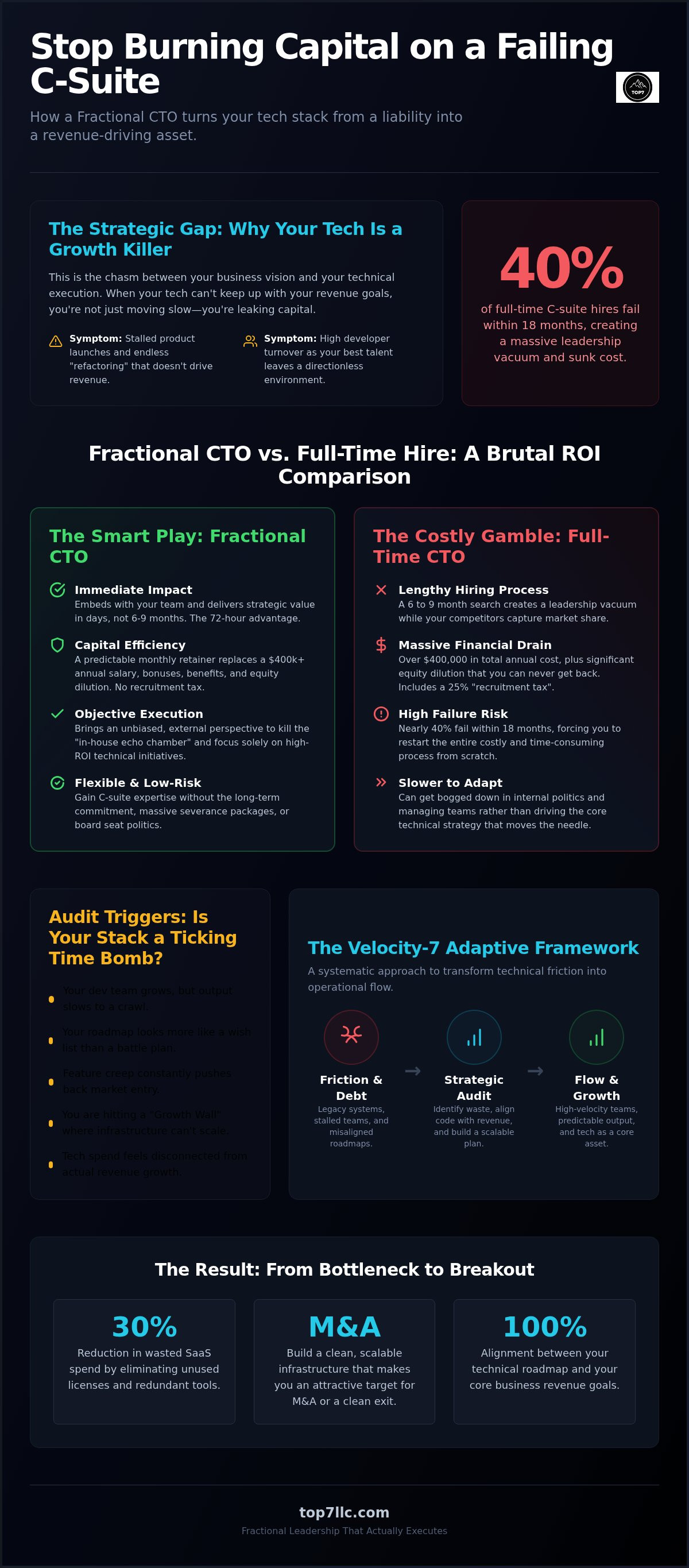
Audit Triggers: When Your Stack Requires an Executive Reset
Most founders wait until their platform crashes or their lead developer quits before they look for help. That is a strategy for failure. You shouldn't wait for a catastrophe to realize your infrastructure is built on sand. Recognizing the "Growth Wall" is the first step toward survival. If your current systems were designed when you were doing $1M in revenue, they will likely buckle before you hit $10M. Engaging a fractional cto for tech stack audit is the only way to identify if your foundation can handle the weight of your ambitions before the cracks become terminal.
The "Founder Bottleneck" is another primary trigger for an executive reset. If you are the CEO but still making final decisions on database architecture or API integrations, you are the primary source of friction. You're slowing down development cycles and preventing your team from taking ownership. Capital is allergic to uncertainty; if your technical roadmap lives only in your head, you have created a massive operational risk that no serious investor will tolerate.
Scaling for M&A and Exit
Investors smell technical debt from a mile away. If you're preparing for an acquisition or a high-valuation exit, your tech stack must be an asset, not a liability. Professionalizing your technical documentation is mandatory to survive the brutal scrutiny of due diligence. You must also remove "Key Man Risk" by decentralizing technical knowledge. If your entire operation collapses because one senior engineer leaves, your valuation will plummet. A strategic audit proves to buyers that your systems are scalable, secure, and ready for integration.
The Interim Leadership Bridge
A sudden CTO departure or a security breach often triggers a panic hire. Boards frequently rush to fill the seat with the first "qualified" candidate they find, leading to the 40% failure rate seen in traditional C-suite placements. A fractional leader serves as an "Audit-First" hire, cleaning house and stabilizing operations before you commit to another expensive, long-term executive contract. This approach allows you to secure interim leadership that executes immediately rather than waiting months for a recruiter to find a replacement. A fractional CTO removes the "panic hire" risk for boards by providing elite stability during a leadership vacuum.
Crisis gaps aren't just about personnel. A security breach or a failed product launch is a clear signal that your current leadership model has failed. You don't need another person to manage the status quo; you need an executive reset. By bringing in an objective external perspective, you can bridge the gap between your current chaos and a future state of operational flow. Stop guessing where the leaks are and start measuring the reality of your technical performance.
Choosing Top7: Fractional Leadership That Actually Executes
Most technical consultants love the sound of their own voice. They'll charge you six figures to hand over a 50-page PDF and then disappear before the first line of code is actually refactored. That isn't leadership; it's a distraction. Top7 is built for mid-market founders who are tired of talkers. We are seasoned professionals who don't just advise from the sidelines. We embed ourselves in your daily operations, taking full accountability for the results. When you hire a fractional cto for tech stack audit from our team, you aren't getting a report. You're getting an executive who manages the execution until the friction is gone.
The Execution Support Difference
We don't just identify the leaks in your development cycle; we plug them. Our approach is based on an embedded execution model where we manage your developers to fix the issues we find. This is agile-based transformation that focuses on moving fast without breaking the business. We understand that you can't stop the train while you fix the tracks. Our CTOs focus entirely on your growth because our success is measured by your margins, not our billable hours. If your current team lacks the discipline to hit deadlines, we reset the standards and lead the stand-ups until high-velocity output becomes the new normal.
A technical roadmap is a fantasy if it doesn't align with the rest of your C-suite. Our fractional CTOs don't work in a vacuum. They collaborate directly with your CFO to align tech spend with capital reserves and with your COO to ensure technical "flow" matches your operational goals. This integrated approach is what separates a strategic leader from a glorified lead engineer. We treat your technology as a financial asset that must produce a measurable return on investment. If your tech spend isn't driving revenue, it's just a hobby; we turn it back into a business driver.
Your Next Step: The Tech Stack Audit
Stop wasting capital on executive overhead and start investing in results. The engagement process is designed for speed and simplicity. There is no HR drama, no messy equity negotiations, and no long-term contracts that anchor your business to an underperforming executive. You'll see an immediate impact within the first 30 days as we apply the Velocity-7 Adaptive Framework to your specific bottlenecks. We move you away from the "Growth Wall" and toward a scalable infrastructure that is ready for an exit or the next $50M in revenue.
The choice is simple. You can keep paying for "strategic advice" that never leaves the paper, or you can hire a leader who knows how to fight for your market share. Stop the friction and start the flow today. Schedule a strategy call with a Top7 Fractional CTO and let's turn your technical debt into a competitive weapon.
Stop Burning Capital and Start Dominating Your Market
Your technical debt isn't just a coding problem; it's a strategic anchor that's holding your revenue hostage. You've seen the brutal ROI comparison. You know that a traditional C-suite hire often results in equity dilution and operational stagnation. The choice is now yours. You can continue to let the "Founder Bottleneck" slow your development cycles, or you can engage a fractional cto for tech stack audit who brings zero-overhead expertise and a bias for execution.
By implementing the proprietary Velocity-7 Adaptive Framework, we move your organization from the chaos of technical friction into a state of high-velocity flow. We don't just hand you a report and walk away. We embed within your team, manage the developers, and professionalize your documentation for the next $50M in growth or a high-valuation exit. It's time to treat your technology as the revenue-driving asset it was meant to be. Take the first step toward a scalable future and scale your business with a Top7 Fractional CTO. Your roadmap to technical dominance starts today.
Frequently Asked Questions
What is the difference between an outsourced CTO and a tech consultant?
A tech consultant gives you a report; an outsourced CTO gives you leadership. Consultants are often passive observers who suggest changes without sticking around to see them through. A Top7 Fractional CTO is an embedded executive who executes the strategy and takes accountability for the results. We don't just point at the problems. We lead the team to solve them. It's the difference between a spectator and a player-coach.
How many hours a week does a fractional CTO typically work for my company?
Engagement levels vary based on your specific needs, but hands-on leadership typically requires 15 to 20 hours per week. You aren't paying for a seat-warmer to fill a 40-hour block. You're paying for high-impact strategic decisions that a less experienced hire might take weeks to reach. We focus on results and output rather than billable hours. This model ensures you get elite C-suite expertise without the overhead.
Can a fractional CTO manage my existing in-house or offshore development team?
Yes, we specialize in managing and professionalizing both in-house and offshore development teams. We stabilize your operations by setting clear KPIs and resetting standards for technical excellence. If your team is struggling with a lack of direction, we provide the leadership they need to move from friction to flow. We act as the bridge between your business goals and their daily code commits, ensuring total alignment.
Is a fractional CTO suitable for a mid-market company that is not a tech firm?
Absolutely. Every mid-market company is a tech company in 2026, whether they realize it or not. If you rely on software for revenue, logistics, or customer acquisition, your stack is a strategic asset. A fractional cto for tech stack audit is especially critical for non-tech firms that often carry massive amounts of hidden technical debt. We help you professionalize your infrastructure so it supports your growth instead of acting as a bottleneck.
What happens if we need to transition to a full-time CTO later?
We prepare your organization for exactly that transition. Our goal is to stabilize your tech stack and build a repeatable execution model using the Velocity-7 Adaptive Framework. Once your operations are efficient and your documentation is professionalized, you'll be in a much stronger position to hire a permanent executive. We help you avoid the panic hire trap by providing elite bridge leadership until you find the perfect long-term fit.
How does the Velocity-7 framework differ from standard Agile methodologies?
Velocity-7 is an adaptive framework that encompasses more than just development cycles. While standard Agile methodologies focus on how engineers work, Velocity-7 focuses on how technology serves the CEO's primary vision. It's a holistic system that aligns technical execution with financial strategy and operational flow. We don't just manage tickets. We ensure every line of code is a tactical move toward your next $10M in revenue.
What is the typical ROI timeframe for a fractional CTO engagement?
You will see an immediate impact within the first 30 days of engagement. During this initial phase, we perform a deep dive into your architecture and identify the leaks in your development cycle. Most clients see significant improvements in team velocity and operational flow by the 90-day mark. We focus on high-leverage changes that produce measurable results quickly, ensuring your investment pays for itself through increased efficiency and reduced waste.
Will a fractional CTO help with M&A technical due diligence?
We are experts at preparing companies for the brutal scrutiny of investor due diligence. A fractional cto for tech stack audit ensures your documentation is professional, your security is tight, and your key man risk is neutralized. We turn your technology from a potential deal-breaker into a primary value driver. Investors smell technical debt instantly. We make sure they see a scalable, secure asset that justifies a premium valuation.


Comments