
Mid-Market Growth: The Velocity-7 Framework for 2026

Why are you still paying for "vision" when your operations are bleeding out? Most mid-market leaders mistake a thick binder for a strategy, but if your plan hasn't left the boardroom, it isn't a strategy; it's a hallucination. In the current economic climate, real business transformation requires more than just a 2026 forecast. It demands a hard pivot from operational friction to a state of efficient flow. You're likely exhausted from wearing every executive hat while technology bottlenecks choke your scale. It's time to stop the bleeding.
You know the frustration of a 90-day cycle that produces nothing but more meetings. We agree that traditional consulting is dead because it lacks skin in the game. This article will show you how to stop creating documents that gather dust and start building an adaptive execution engine that drives measurable revenue growth. We'll break down the Velocity-7 Framework, a system designed to turn strategic intent into tactical victory. You'll learn how to access high-level C-suite expertise without the dead weight of a full-time payroll, ensuring your growth is fast, lean, and relentless.
Table of Contents
Why Your Current Strategic Plan is Already Obsolete
Most mid-market leaders are suffocating under the weight of static five year plans that were obsolete before the ink dried. Research suggests that 70% of strategic plans fail to reach execution because they ignore the reality of operational friction. These documents are built for a world that stays still, but the market in 2026 doesn't wait for your quarterly board meetings. Achieving a real business transformation requires moving away from the "Plan on a Shelf" syndrome and toward a continuous loop of assessment and action.
Effective business transformation philadelphia isn't a one-time event; it's a relentless 90-day agile execution cycle. Traditional consulting firms often drop a massive report on your desk and vanish, leaving a leadership vacuum that your overstretched team can't fill. They give you the "what" but fail miserably on the "how". You don't need more advice. You need an execution engine that turns strategy into profit without the fluff.
To better understand the scale of change required for modern growth, watch this analysis of large-scale shifts:
The High Cost of Operational Friction
Hidden bottlenecks are the silent killers of strategic momentum. When your executive team spends 80% of their time fighting daily fires, they have zero capacity left for scaling. Trying harder isn't a strategy; it's a recipe for executive burnout. If you're wearing five different hats, you aren't leading; you're just a highly paid bottleneck. Scaling a mid-market firm requires a fundamental shift in how you handle business transformation philadelphia. You must identify where the friction is slowing down your flow and eliminate it with surgical precision.
Static vs. Adaptive Models: Choosing Your Weapon
Static models are for companies that want to die slowly. In a volatile environment, a generic wish list is a liability. You need a tactical roadmap that allows for real-time pivots based on hard data, not gut feelings. The difference between a stagnant vision and a growth engine is the ability to adapt every 90 days. Adaptive Strategy is the systematic ability to reallocate resources and recalibrate tactics in real time to exploit market volatility rather than being crushed by it. Stop building monuments to the past and start building a roadmap for the future.
The Velocity-7 Adaptive Framework: A New Dimension of Growth
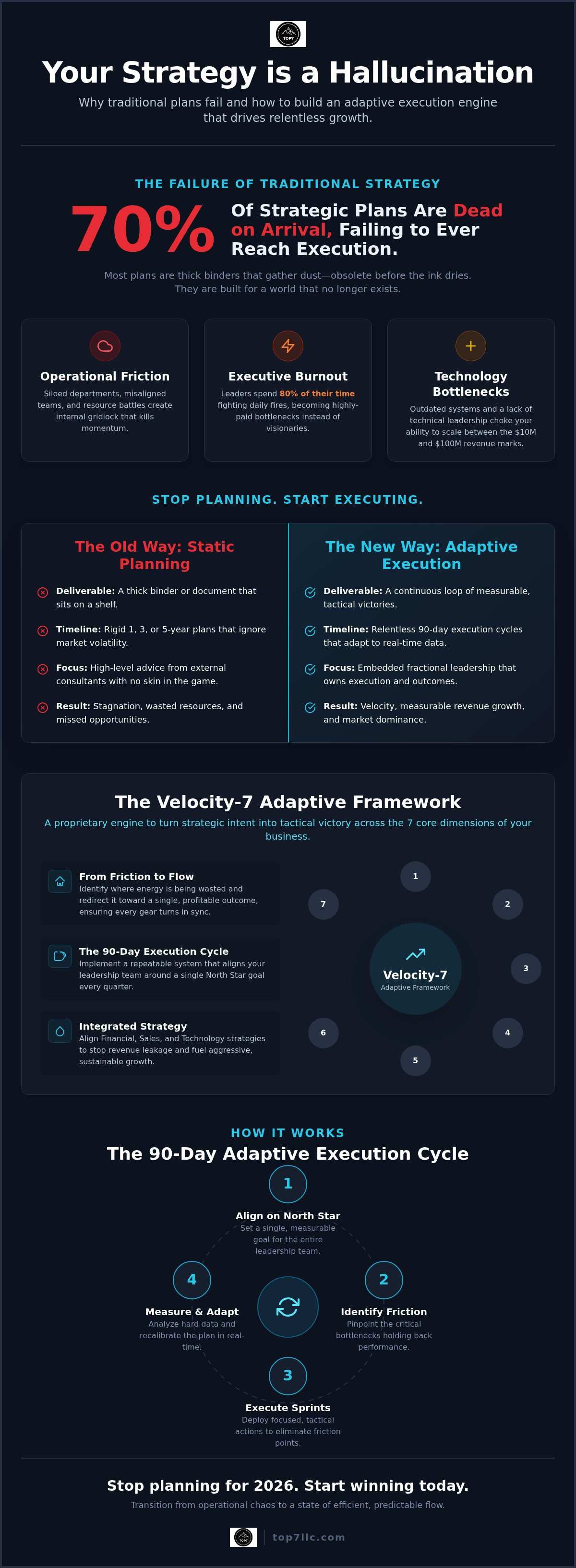
If your strategy doesn't account for the seven core dimensions of your business, you're flying blind. Most mid-market firms operate in a state of constant friction, where departments fight over resources and data lives in silos. The Velocity-7 Adaptive Framework changes the game. It isn't just another methodology; it's a proprietary engine designed for agile transformation. By moving your organization from friction to flow, we ensure that every gear in your machine turns in sync toward a single, profitable outcome. This is how you win in the landscape of business transformation philadelphia.
The core philosophy is simple: identify where the energy is being wasted and redirect it toward growth. We don't just hand you a report. We embed the framework directly into your operations, ensuring that Adaptive Strategic Execution becomes your new standard. This isn't about incremental gains; it's about a total system overhaul that places technical leadership at the center of your planning. If you aren't leading with technology and data, you're already behind.
Integrating Financial and Sales Strategy
Revenue leakage is often the result of a CFO and a CRO who don't speak the same language. Your financial strategy shouldn't just be about cutting costs; it must fuel aggressive sales targets. Velocity-7 aligns capital strategy with market reality, ensuring that your sales team has the resources they need to crush their numbers. When these two departments are in sync, you stop guessing and start scaling. If you're ready to see how this alignment looks in action, explore our Velocity-7 Adaptive Framework details.
Technology as a Growth Accelerator, Not a Bottleneck
In 2026, technology strategy is business strategy. Period. If your tech stack is a collection of legacy systems that don't talk to each other, it's a bottleneck, not an asset. A Fractional CTO audits your infrastructure to ensure it supports your strategic goals rather than hindering them. This isn't just about IT support; it's about strategic alignment. By placing technical leadership at the boardroom table, you transform your technology from a cost center into a high-octane growth accelerator. Stop letting outdated systems dictate your ceiling.
Strategic Planning vs. Strategic Execution: Closing the Leadership Gap
Mid-market companies often hit a glass ceiling between $10M and $100M. It isn't because the market shifted or the product lost its edge. It's because the leadership team is redlining. This "Leadership Gap" occurs when the complexity of the business outpaces the capacity of the people running it. You can't scale a $50M enterprise with the same "all-hands" chaos that worked at $5M. Closing this gap is the core of any real business transformation philadelphia. If your executive team is too busy wearing multiple hats to actually lead, your strategy is already dead.
Traditional consulting doesn't solve this. A consultant hands you a binder of advice, collects their fee, and leaves you to figure out the implementation. That's not leadership; it's a homework assignment. Real growth requires execution, not just planning. Whether you need a Fractional CEO to steer the ship or Interim Leadership to navigate a crisis, the focus must be on results. Sometimes, the team that got you here isn't the team that can take you to the next level. That's a brutal reality, but ignoring it is a choice to fail.
Fractional Leadership: The Sustainable Path to C-Suite Results
You don't need to bloat your payroll with a $300,000 executive salary to get elite strategy. Fractional leadership allows you to plug high-level expertise directly into your organization for a fraction of the cost. Through a monthly retainer model, you gain access to seasoned veterans who have already solved the problems you're currently facing. It's about precision. You get the specialized expertise of a Fractional CFO or CMO exactly when you need it, without the long-term liability of a full-time hire. This flexibility is a competitive weapon in volatile markets.
Solving Complex Problems through Embedded Support
Embedding a professional into your operations is fundamentally different from hiring a consultant. A consultant audits; an embedded leader transforms. When a Fractional COO joins your team, they aren't just looking at spreadsheets. They're identifying friction points, optimizing workflows, and holding the team accountable to 90-day execution cycles. They become part of the fabric of your business. If you're struggling to move from operational chaos to efficient flow, you don't need another audit. You need a partner who can drive active organizational transformation from the inside out. Don't settle for advice when you can have an execution engine.
Building an Adaptive Roadmap: The 90-Day Execution Cycle
Stop waiting for annual reviews to fix your broken processes. A five-year roadmap is a fantasy that ignores the speed of the modern market, leaving your company vulnerable to competitors who move in weeks rather than years. If you want real business transformation philadelphia, you need a 90-day execution cycle. It starts with a brutal Organizational Audit. We look at all seven dimensions of your business to find the friction points that are bleeding your resources. Once the friction is exposed, we define the North Star. This isn't a vague mission statement; it's a single, measurable goal that aligns your board and C-suite on a unified front.
We break that vision into 90-day sprints. This is agile methodology applied to the entire business, not just the dev team. You move fast, hit milestones, and recalibrate. But you can't manage what you don't measure. Forget vanity metrics like social engagement or brand sentiment if they aren't tied to the bottom line. We establish Key Performance Indicators (KPIs) that actually matter. Then, we install the feedback loop. These are weekly tactical meetings designed to adjust course before a small detour becomes a fatal wreck. If you aren't pivoting, you're just waiting to crash.
Measuring What Actually Matters
Growth-driving data is the only currency that counts in a competitive market. The Velocity-7 framework tracks progress across both financial and operational planes, ensuring your growth is balanced and sustainable. Don't let vanity metrics lie to you about the health of your firm. In a business context, the 'Flow State' is the point where strategy and execution become a single, frictionless motion that generates predictable revenue. If you aren't hitting this state, your data is already screaming at you where the block is. Listen to it.
The Role of Advanced Project Management
High-stakes projects fail because of strategic drift. You start with a bold goal and end with a task list that has nothing to do with your original intent. Advanced Project Management bridges the gap between executive strategy and daily tasks. We manage the execution phase with a zero-drift policy, ensuring every action taken by your team directly supports the North Star. Ready to stop the drift? Learn more about our Advanced Project Management services to see how we turn stagnant plans into high-velocity reality.
The Top7 Approach: From Operational Friction to Efficient Flow
Strategy without execution is just expensive daydreaming. Most firms fail because they treat these as two separate phases; at Top7, we treat them as one. We focus on "Flow," the rare state where your strategic intent and daily operations move in a single, frictionless motion. This isn't a vague concept. It's the result of implementing the Velocity-7 Adaptive Framework, a proprietary engine built to drive relentless growth. If you're tired of watching your competitors outpace you while your team struggles with the same old bottlenecks, you don't need a new plan. You need a new engine.
Fractional leadership is the only logical cure for the executive burnout crisis. When your current leaders are wearing too many hats, they aren't leading; they're just surviving. By embedding a Fractional CEO or COO, you inject immediate C-suite expertise into your organization without the $300,000 overhead. This is the cornerstone of effective business transformation philadelphia. During the first 30 days of a partnership, we don't waste time on endless discovery sessions. We perform a brutal audit, define your North Star, and launch your first 90-day execution cycle. We start delivering results on day one because your market doesn't have a pause button.
Why Mid-Market Companies Choose Fractional C-Suite
Mid-market firms often stall because they can't afford a full bench of elite executives, yet they can't grow without them. The cost-benefit of fractional leadership is undeniable. You get the specialized expertise of a Fractional CFO or CMO at a fraction of the cost of a full-time hire. More importantly, you gain access to a team of seasoned professionals rather than a single generalist. Implementation happens at lightning speed. We don't spend months "learning the culture." We spend hours identifying friction and minutes starting to fix it. This is how you achieve business transformation philadelphia while staying lean and mean.
Your Next Move: Auditing Your Strategic Readiness
Before you start another planning cycle, ask yourself: Does my team have the bandwidth to execute this? Are our growth obstacles operational or strategic? If you can't answer these with absolute certainty, you're just guessing. You need to move from operational friction to efficient flow before your market passes you by. Don't settle for a resource library when you need a leader who has been in the trenches. It's time to stop the bleeding and start the scaling. Partner with Top7 and turn your stagnant strategy into a high-velocity execution engine.
Execute Your Vision or Get Out of the Way
The market in 2026 doesn't reward visionaries; it rewards executors. If your strategy is still a static document gathering dust, you aren't leading; you're just hoping for the best. Real business transformation philadelphia is about shifting from operational chaos to a state of high-velocity flow. You've seen why traditional plans fail and how the Leadership Gap stalls mid-market firms. Now, it's time to act.
Our proprietary Velocity-7 Adaptive Framework is a battle-tested engine for results. By embedding seasoned C-Suite professionals directly into your team, we replace executive burnout with relentless 90-day execution cycles. We don't just audit your friction; we eliminate it. This is about building a sustainable, adaptive system that drives measurable revenue growth and tactical superiority.
Are you ready to stop wearing every hat and start scaling with precision? Under the leadership of experts like Michael J. DiPiano Jr., Top7 turns strategic intent into tactical victory. Ready to move from friction to flow? Schedule a strategy audit with Top7. Your future growth depends on the decisions you make today. Let's get to work.
Frequently Asked Questions
What is the difference between strategic planning and strategic execution?
Strategic planning is the "what," while strategic execution is the "how" that actually moves the needle. Most companies fail because they stop at the planning phase. Execution requires embedded leadership and a relentless focus on 90-day cycles. Without an execution engine, your strategy is just a document gathering dust. Closing the leadership gap ensures that your vision translates into measurable revenue growth rather than staying trapped in the boardroom.
Why do most strategic plans fail in mid-market companies?
Most plans fail because they are static documents that ignore operational reality. Mid-market companies often hit a glass ceiling because their leadership team is too busy fighting fires to execute a complex roadmap. This lack of executive bandwidth creates a disconnect between strategic intent and daily tasks. Without a repeatable execution cycle and clear accountability, even the best plans become obsolete before they can be implemented.
How does the Velocity-7 Adaptive Framework improve business growth?
The Velocity-7 Adaptive Framework improves growth by transforming operational friction into efficient flow. It systematically addresses seven core dimensions of your business, from technology to financial strategy. By breaking down silos and aligning the entire organization around a single North Star, the framework ensures zero strategic drift. This agile-based approach allows your company to pivot in real time, turning business transformation philadelphia into a competitive weapon rather than a one-time project.
What is a Fractional Executive and how do they help with planning?
A fractional executive is a seasoned C-suite professional who embeds directly into your team on a part-time basis. They provide high-level strategic guidance and execution support without the $300,000 overhead of a full-time hire. These leaders solve the executive burnout crisis by taking over specialized roles like CTO or COO. They don't just offer advice; they actively manage the transformation process to ensure your strategic goals are met.
How often should a company update its strategic roadmap in 2026?
You should recalibrate your strategic roadmap every 90 days to stay competitive in a volatile market. A five-year plan is a fantasy in 2026. Agile 90-day sprints allow you to test assumptions, measure results, and adjust course based on hard data. This frequency ensures your business transformation philadelphia stays aligned with market shifts. If you aren't updating your tactics quarterly, you're likely following a roadmap to a destination that no longer exists.
What is the cost difference between a consultant and a fractional leader?
Consultants typically charge fixed project fees for a deliverable, while fractional leaders operate on a monthly retainer for ongoing execution. The cost of a consultant is often tied to a report that may never be used. In contrast, a fractional leader provides continuous C-suite expertise at a fraction of the cost of a full-time executive. This model allows mid-market firms to access elite leadership and sustainable ROI without bloating their permanent payroll.
What are the signs that my business is suffering from operational friction?
Signs of operational friction include executive burnout, technology bottlenecks, and a general state of operational chaos. If your leadership team is wearing too many hats and struggling to complete daily tasks, you have a friction problem. Other indicators include revenue leakage and strategic plans that never reach the execution phase. When your internal processes feel like a constant struggle rather than a smooth flow, it's time for a system overhaul.
How long does it take to see results from an adaptive strategic plan?
You should see initial results within the first 30 days of implementing an adaptive strategic plan. This period focuses on identifying friction points and aligning the C-suite on a single North Star goal. Measurable improvements in efficiency and revenue growth typically emerge by the end of the first 90-day execution cycle. By moving fast and recalibrating often, you ensure that the transformation process delivers immediate and compounding value to the business.


Comments